
| Technical Brief on Coronado's Experimental Systems | |
| Biometric Computer Technology: | ||
| An enhancement on the principle of bioneural computer circuitry, biometric computer circuitry mimics the function of an organic brain to process computer information more efficiently, especially as regards data prioritization. Biometric computers attempt to predict the actions of the crew or the data they might need and have that data or action ready in advance of its being required, thereby dramatically reducing response delays. Because biometric systems are based on bioneural technology, they suffer from the same drawbacks as the older technology: they are difficult to maintain, somewhat tempramental, and prone to suffer from conditions affecting other biological life aboard the ship. To partially counter this, biometric computer systems are often enhanced with synthetic immunities to virii in their RNA chains. This, however, sometimes has its own drawbacks: the biometric systems sometimes react to parasites or pathogens in the ship's atmosphere. | |
| Cluster Torpedoes: | ||
The Advanced Cluster Torpedo utilizes a standard quantum torpedo casing, propulsion, and guidance system, but instead of a single warhead, contains a large number of 13cm quantum microtorpedoes. When the torpedo reaches proximity to the target's or target area's shields or hull, the torpedo casing disintegrates, deploying the microtorpedoes in a "shotgun" or other programmed pattern. The microtorpedoes can also be programmed to seek nearby individual targets or be deployed in a minefield configuration. The cluster torpedo is especially devastating as an anti-fighter point defense weapon: when deployed in a spread along the approach vector of an incoming fighter group, very few of the attacking fighters will survive this wide-area attack. However, this torpedo is also effective in capital ship engagements, spreading its damage in a much wider area than a standard quantum torpedo. Finally, these torpedoes could be used in a pattern to search for hostile cloaked vessels over a wide area. | ||
| Emergency Medical, Engineering, Security Holograms: | ||
 As the holographic technology aboard Federation starships becomes more and more complex
and capable, the possibilities inherent in this new medium are being explored
by Starfleet's engineers. The various Emergency Holographic programs are one area
being worked in. The "Savant" AI interface is another. Savant, unique to the
Coronado and other Katana-class frigates is a holographic "interface" into the
main computer core. Savant is designed to act as a sort of interpreter to the
computer to more efficiently direct Coro's computing resources to the tasks at
hand in any given situation.
As the holographic technology aboard Federation starships becomes more and more complex
and capable, the possibilities inherent in this new medium are being explored
by Starfleet's engineers. The various Emergency Holographic programs are one area
being worked in. The "Savant" AI interface is another. Savant, unique to the
Coronado and other Katana-class frigates is a holographic "interface" into the
main computer core. Savant is designed to act as a sort of interpreter to the
computer to more efficiently direct Coro's computing resources to the tasks at
hand in any given situation.Savant can take orders, search the ship's database, or can appear to operate any console. It is possible for a single person to fly Coro and operate her systems using Savant as a go-between. The interface literally is the personification of Coronado. In addition to these duties, Savant can monitor the current mission and make information related to the mission available to key officers or personnel from the ship's database. "She" (Savant, by default, is displayed as a human female of indeterminite race) can also direct the actions of the other holographic programs aboard ship and in so doing start repairs on the ship and aid to the crew in the event of a ship-wide disaster that disables the sentient officers and crew aboard. Not quite sentient in the base configuration, the interface is limited to the locations aboard Coronado that are fitted with holographic emitters. However, Savant can also participate in Away teams using Coro's holographic projection system, so long as the ship remains within 25,000 kilometers of the surface of a planet or the site of an Away mission. Having the full resources of the ship's main computer so available is often a tremendous advantage!
The Emergency Security Hologram, or ESH, is an experimental program designed to confuse Threat forces in cases where the ship is boarded. The computer forms the ESH visually from the images of random ship's crew in the area, and up to eight ESH programs may be running simultaneously. The ESH allows Security or other ship's personnel in the area of potential Threat force boarders to use the ESH as decoys -- the hope is that boarders will fire at the holographic personnel instead of the real ones. The ESH is extremely limited at this time, and cannot do much more than chase boarders while wielding a holographic phaser at them.
| ||
| "False Matter" Torpedo: | ||
| The false matter torpedo consists of large torpedo casing and load, approximately twice the volume and four times the mass of a standard quantum torpedo. Instead of explosive ordnance, the false matter torpedo carries a large plasma matter/energy store, a midrange replicator cluster and a series of emitter grids spaced throughout the torpedo casing. Approximately four seconds after launch, the torpedo "arms itself" by activating the internal replicator to generate a shell of false matter across the leading edge of the torpedo. This renders any shielded target immune to false matter torpedoes; false matter is incapable of damaging any sort of energy field or forcefield. However, against a non-shielded target, it turns the torpedo into what is essentially a flying drill-bit: the torpedo can and will burrow into any unshielded target that it strikes. For some reason yet to be determined, in the M64 galaxy, "false matter" (a substance/energy field whose properties are still being studied) can pass through any normal matter. Upon reaching a pre-programmed "depth" within the target, "detonation" occurs, which is very different from a standard torpedo detonation. Instead of exploding, the torpedo's internal replicator converts the matter/energy store into a series of six to ten false matter "wires." These wires are generated along moving "trajectories" within the target, essentially becoming moving blades, chopping the target area to pieces from within. However, a false matter torpedo "detonation" is unique in that it relies entirely on secondary effects to damage the target. If the torpedo and its attendant false matter wires fall entirely within a shuttlebay or fuel tank, for instance, and the wires slice nothing, no damage will be done to the target and the torpedo will fall idle and inert inside the target. However, if the target interior spaces are well understood, a large number of shorter wires created within the target's engineering spaces, for instance, will likely cause catastrophic damage to the target with only a single strike. The false matter torpedo was devised in the M64 galaxy for use against Pfhor warships. These warships, which can be 2,000 meters long or longer, have demonstrated only two vulnerabilities. First, they rely on incredibly thick armor over shields (which they do not carry or use); and second, they remain relatively motionless in combat, relying on their thick skins to protect them. To date, standard Starfleet ordnance has been only marginally effective in penetrating Pfhor armor. It is hoped that the false matter torpedo will make Starfleet vessels a credible threat to Pfhor warships. | |
| Heavy Graviton "Lance": | ||
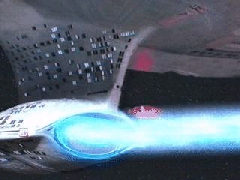 First demonstrated as practical by U.S.S. Enterprise, NCC-1701-D in 2366, the
so-called "Lance" heavy graviton discharge uses the deflector array of a starship to
generate an enormously powerful beam of energy at high frequencies. Originally intended
as an anti-Borg weapons system, it was later found that the Borg had adapted to
high-frequency energy discharges.
First demonstrated as practical by U.S.S. Enterprise, NCC-1701-D in 2366, the
so-called "Lance" heavy graviton discharge uses the deflector array of a starship to
generate an enormously powerful beam of energy at high frequencies. Originally intended
as an anti-Borg weapons system, it was later found that the Borg had adapted to
high-frequency energy discharges.Use of this weapon requires that the deflector array be charged for at least two hours for a 10-second discharge, but the discharge will be more powerful than the combined output of the rest of the starship's weaponry, and the discharge can be very precisely targeted. The disadvantages of the Lance are many. First, the discharge will irradiate the area for several dozen meters around the deflector array, requiring that the area be evacuated and later repaired using radiation protocols. Second, use of the Lance frequently overloads the main power systems of the starship using it. Third and finally, shields cannot be raised during the Lance charging sequence (two hours); doing so will neutralize any charge built up to that point and may overload the graviton emitters, rendering the shields useless until repaired. | ||
| Holographic Defense System: | ||
Mounted in six strategic locations along the ship's outer hull is the Holographic Defense System. From the Operations Manager's console on the Bridge, the ship can project "phantom" holographic images of nearly anything in the ship's database, most often images of enemy or friendly ships, or ship's missile weapons, such as phantom quantum torpedoes. When used in conjunction with a high energy subspace field and/or thoron field emissions, the ship can potentially spoof Threat force vessels into believing the phantom images actually exist. Great care must be taken when using the HDS: it is extremely energy intensive, often requing that one or more of the other ship's power systems be temporarily shut down while the HDS is in operation. Most commonly, phaser power is routed to the HDS when at Alert status, requiring that the ship forgo the use of the phasers while the HDS is in operation. However, other major power systems (such as impulse maneuvering, shields, the IDF/SIF, primary life support, etc.) may be used instead. | ||
| Holographic Projection Viewer: | ||
Located on the main Bridge and replacing the main viewscreen is the Holographic Projection Viewer (HPV). Incorporating the latest in Federation holographic technology, this viewer's advantages are two-fold. First, external views are projected in a holographic space, similar to the operation of the ship's holodecks. This allows the Bridge officers to discern their ship's position more easily relative to objects outside the ship, such as other starships, bases, or planets. Second, when used for communication, the HPV builds a three-dimensional model of the lifeform(s) being communicated with based on extrapolation of visual data (or incoming HPV data if available), allowing more efficient communications. | ||
| Hornet Type 14 Shuttlecraft: | ||
Originally designed as a light anti-terrorism fighter, the type 14 shuttlecraft has lately found favor with Starfleet's frigate and destroyer commands. Smaller starships are generally lacking in shuttlebay capacity, and sometimes make do with smaller shuttlecraft to compensate for the reduced room aboard. For these purposes, the Hornet type 14 shuttle is ideal. Capable of carrying four passengers in relative comfort, the shuttle can also double as an armed escape pod or interceptor. With a cruising velocity in the warp 4 range, medium-duty shield generators, and two phaser banks, Hornets are both fast and survivable. They are also versatile, and can be mounted with a variety of external modules. Most commonly, a microtorpedo launcher is carried.
Hornets are not generally given names, but Coro's are known informally as Cortez, de Leon, Vega, and Santiago. Less than three meters tall and only ten meters long, Hornets require a minimum of deck space; spare parts are also similarly compact. Coronado generally carries modules rendering the Hornets capable of firing microtorpedos, running sensor scan or data-gathering operations, providing electronic countermeasures, or acting as a transporter relay. With the sensor module in place, Hornets can also act as armed sensor relay pods for the starship. While it is unlikely that these relatively small shuttles will come into general use aboard larger starships, for smaller ones the Hornet has proven ideal. | ||
| Kelaka Class Captain's Yacht: | ||
Kelaka is a custom-built multi-role mission support vehicle attached to U.S.S. Coronado as her Captain's Gig. He (Cardassian ships are generally referred to as "he") was designed by Commander Fornan Dejat, and first launched in January 2401. More detailed information about the design goals of the Kelaka team is available. Kelaka was built with the combined efforts of Commander Dejat, then-Lieutenant Zunite Oswald, and then-Lt. Commander William Daren. You may also wish to review Kelaka's formal specifications.
His equipment package includes an extremely powerful communications array, a powerful computer system, and a custom-built stealth device. While the stealth device is not as effective as a cloaking device, it does shield the vessel from visual scans and is ninety-seven percent effective at avoiding other forms of scans. When in stealth mode, Kelaka also minimizes emissions. Due to his size, he is extemely difficult to locate when operating under these parameters. Kelaka is launched from Coro's lower saucer Captain's Gig mount. | ||
| LORASON Sensor Array: | ||
Combining nearly everything learned to date about starship sensor and observation technology, the LORASON sensor pod is quite possibly the single greatest achievement in long-range sensors in the past century. LORASON, which stands for Long-Range Astrometric/Sensor/Observation/Navigation, is a technology that was first deployed in 2380 after decades of research and development by the Federation's greatest minds. The LORASON array, mounted aboard U.S.S. Coronado, NCC-97901, provides high-resolution long-range sensor scans to a range of 21 light-years, more than triple any previous sensor technology. Even more important, low-resolution range has been increased to more than 60 light-years. The LORASON array aboard Coro is built into a series of dedicated modules in conformal mounts above and below the frigate's main deflector and long range sensor cluster. Advanced bioneural computing capacity installed in the modules also allow for real-time processing and observation of sensor data, displaying it in a holographic Stellar Cartography facility on deck 9, forward of Coro's Command Information Center (CIC). Even more impressive, the computer capacity in the LORASON module allows Coronado to combine sensor data available from dozens of platforms and display that data on a single screen or in the CIC. It is theoretically possible for the commanding officer of Coronado or embarked Admiralty to observe and direct the movements of hundreds of Starfleet vessels for a variety of purposes, including defense, response to distress calls, relief to Federation members, colonization, transport, exploration... the possibilities are endless. | ||
| Minerva Type 12 Warpshuttle: | ||
 Still a very popular design despite their age, the Minerva class shuttlecraft are a common
sight on Federation starships, space stations, and ground facilities. Minervas are used to
handle secondary mission objectives, light transport duties, or personal or fleet business at
medium ranges.
Still a very popular design despite their age, the Minerva class shuttlecraft are a common
sight on Federation starships, space stations, and ground facilities. Minervas are used to
handle secondary mission objectives, light transport duties, or personal or fleet business at
medium ranges.A good balance between a large shuttle and a small runabout, these ships are incredibly tough and versatile. They will easily accomodate seven passengers and their cargo, and can be refitted for a variety of applications. Minervas can be handled by a single pilot, or two people can split the flying duties. Her twin microwarp engines are modernized versions of those originally carried by the Danube class runabout and allow the type 12 shuttle to cruise at speeds exceeding warp 7 for a period of more than a week.
| ||
| Multispatial Shielding: | ||
 Based on captured Borg technology, as well as the metaphasic shielding technologies of the
late Nobel / Zee Magnees prize-winning Dr. Reyga, multispatial shielding involves generating
low-level subspace fields, causing the object within the fields to exist partially in
subspace. The object will be rendered partially "out of phase" with normal space-time,
allowing the object to enter areas of space normally inaccessible, such as the atmosphere of
a gas giant, the corona of a star, or a dark matter nebula.
Based on captured Borg technology, as well as the metaphasic shielding technologies of the
late Nobel / Zee Magnees prize-winning Dr. Reyga, multispatial shielding involves generating
low-level subspace fields, causing the object within the fields to exist partially in
subspace. The object will be rendered partially "out of phase" with normal space-time,
allowing the object to enter areas of space normally inaccessible, such as the atmosphere of
a gas giant, the corona of a star, or a dark matter nebula.Most commonly used on probes or shuttlecraft, multispatial shielding is incapaple of so protecting an object of greater than 75,000 kilograms of mass, or larger than approximately 20 meters in length. In these applications, metaphasic shielding can be used, but is comparitively much less reliable. For these reasons, when close observation of hazardous phenomenon is required, a multispatial-capable probe is most often used. | ||
| Quantum Phase Inversion ("Slipstream") Propulsion: | ||
 Quantum phase inversion propulsion -- the so-called "slipstream drive" -- is a technology
that has come a long way in the last eight years. The technology was originally discovered
by U.S.S. Voyager, NCC-74656 during her passage through Delta quadrant, and was
actually successfully used by that vessel twice, in 2375 (for approximately 47 seconds) and
in 2377 (for several hours). It was the excitement of Voyager's use of slipstream
in her journey home that prompted experiments into the technology.
Quantum phase inversion propulsion -- the so-called "slipstream drive" -- is a technology
that has come a long way in the last eight years. The technology was originally discovered
by U.S.S. Voyager, NCC-74656 during her passage through Delta quadrant, and was
actually successfully used by that vessel twice, in 2375 (for approximately 47 seconds) and
in 2377 (for several hours). It was the excitement of Voyager's use of slipstream
in her journey home that prompted experiments into the technology.Unfortunately, that excitement was short-lived: it was discovered that Voyager's successful use of slipstream was a fluke, and the ship could have been destroyed or severely damaged by her use of it. In theory, quantum phase inversion involves creating a bubble of quantum subspace, into which the starship is inserted. That bubble is then linked through a conduit to a distant point in space. The bubble transits through the conduit very quickly, appearing to cross enormous distances in very little time. Once the destination is reached, the bubble is collapsed and the starship emerges into real space at her destination.
After years of frustrating research, a rather embarrassing breakthrough was made in 2391 when it was discovered that the testing methodology itself was flawed: all of the ships used in prior experiments included warp nacelles, included as part of the matter/antimatter power system as a matter of course. When this seemingly obvious oversight was remedied, several possible theoretical models for successful transit through a slipstream conduit emerged. Soon after, it was realized that a slipstream-capable ship could incorporate warp nacelles if a method to render them energy-neutral was included also, and their z-axis compression was within a very thin tolerance. The race to build a slipstream-capable starship was on.
From an external perspective, slipstream conduits are extremely easy to track, and are quite obvious to even relatively primitive sensors. Therefore, they should not be used near planets settled by low technology civilizations protected by the Prime Directive. Further, the obvious nature of the conduit's formation effectively announces the arrival of a slipstream-capable starship as much as 20 seconds before the starship can exit the conduit. This is a significant tactical disadvantage. Much like transwarp conduits, slipstream conduits can also be disrupted by high-energy explosions across their subspace threshhold or transition path. A ship outside the conduit but in the path of it can therefore bring the slipstream-capable vessel out of the slipstream with a well-placed torpedo blast or use of similar weaponry. If the helm officer's reflexes are not sufficient to the task, a starship caught in such a disruption will certainly be destroyed. Finally, slipstream is a singularly inexact science at present. Local electromagnetic field flux values and local subspace field densities can greatly influence the speed at which a starship passes through the conduit. In areas of high electromagnetic field flux or low subspace field densities (such as the vicinity of planetary systems), the transit speed decreases dramatically. In comparitively more empty interstellar space, the transit speed can become dangerously high. These drawbacks, while significant, have not delayed the promise of the quantum phase inversion propulsion system. There is one simple reason: slipstream is fast. A vessel passing through such a conduit can reach average speeds the equivalent of warp 9.9998, or approximately 140,000 times the speed of light. Slipstream holds the promise of forever changing Starfleet's reach in the cosmos; therefore, the experiments will likely continue well into the future. A new age could very well be dawning! | ||
| Sensor Relay Pods: | ||
In search operations, many starships are limited by the relatively short range of the ship's high-resolution sensors, which average 7 light-years for nominal return of information. Sensor relay pods, which can be launched as probes from the starship, allow the ship to cover a much wider area. Information from up to four pods, each with its own 7 light-year scanning radius, can be processed by the ship's computer at one time, and the pods can either track with the ship as it moves, or be picked up, refueled, and deployed again. Coronado's four sensor relay pods are sometimes mounted to the hardpoints of one of the frigate's two Spectre fighter wings, allowing the Spectres to perform reconnaissance missions consistent with pre-combat target selection or combat search and rescue (CSAR). Kelaka is also capable of mounting one of the pods for either mission as well, though doing so interferes with that ship's natural stealthy profile. | ||
| Spectre Class Fighter: | ||
As the number of races that use small one- and two-person starships for attack and defense increase, Starfleet has an increasing need to defend specifically against these smaller ships. The Spectre class fighter is a leading single-seat fighter design in use. It was also one of the first ships to be fitted with the experimental soliton wave warp drive replacement technology. You may wish to review the Spectre's formal specifications.
Pound-for-pound, it is the most deadly weapon ever devised, and in its standard wing of four ships, is a credible threat to even small capital ships. The Spectre has proven amazingly difficult to hit even with phasers, and many sensor systems fail to lock on this small, elusive target. It is currently in widespread use by the Starfleet Marine Corps and Starfleet Secret Service. Coronado fields eight Spectres in two wings, TFW-47, the "Thunderbirds," and TFW-119, the "Thundercats." Coro, as a Flight 2 Katana class frigate, includes an upper launch "catapult" on deck 3 aft of the Bridge capable of deploying one of these wings (usually TFW-119). | ||
| Starship Landing Sequence: | ||
Some smaller Starfleet vessels, such as Intrepid class destroyers and Katana class frigates, are able to safely land on a planetary surface. The planet to be landed on must fall within rather strict tolerances for gravity, atmospheric pressure (if an atmosphere exists), and surface stability. However, if the planet falls within these parameters, a landing may be attempted if the commanding officer feels that such is warranted by mission requirements, crew safety, or other factors.
Under the guidance of the flight controller, the starship is brought through the planetary atmosphere to a stable, level surface suitable for the starship's mass. Once there, the starship deploys landing struts and transfers available power from the ship's graviton generators to those struts. The struts are generally incapable of supporting the full starship's mass -- the additional power routed to the graviton generators serves to "lighten the load" by artificially accepting a portion of the starship's weight and hold it stable on the surface. Once on the surface, the starship can use sensors, weapons, and other ship's systems more or less normally. Once the business of the vessel on the surface is concluded (assuming that the landing was not one of an emergency nature), the starship can then use reaction control and impulse systems to climb back into orbit. In a very few rare cases, a starship may choose a planetary landing as an emergency measure. In these cases, the commanding officer may override some of the parameters normally associated with an "acceptable" planet for Blue Alert, depending on the severity of the situation. In these cases, it is assumed that the starship will be unable to climb back into orbit under her own power, and a landing is the only thing that will save the lives of the crew. Once the starship has landed, subspace transmitters can be used to contact Starfleet, which may have the means to repair the vessel or tow her back into orbit and to a Federation facility. | ||
| Once you're done here, tap Back to return to the Coronado information index or the Return key at the bottom of your PADD, and you will be returned to the main index. | ||
| The U.S.S. Coronado model was created by Ryan McClure. The Katana class design was created by Rick Sternbach, and appeared in the ST:TNG Technical Manual. It was modified for U.S.S. Coronado by Mark Kingsnorth, Fraser Deziel, and Ryan McClure. Reproduction or use of Coronado images in any form is strictly prohibited without the prior written authorization of the site author and digital modeller per this site's terms of use. |





 Star Trek®,
Star Trek: The Next Generation®, Star Trek: Deep Space Nine®, and Star Trek: Voyager®
are registered trademarks of Paramount Pictures
in the United States Patent and Trademark Office. Use of this site constitutes your
acceptance of these terms of use.
Star Trek®,
Star Trek: The Next Generation®, Star Trek: Deep Space Nine®, and Star Trek: Voyager®
are registered trademarks of Paramount Pictures
in the United States Patent and Trademark Office. Use of this site constitutes your
acceptance of these terms of use.
|
 The standard holographic program aboard most Starfleet vessels is the Emergency Medical
Hologram, or EMH. Designed as a short term supplement to the ship's medical personnel,
the EMH is capable of instantaneous transfer to any point on the ship that contains
holographic emitters (aboard Coronado, this includes the Bridge, Engineering,
Sickbay, holodecks, all Shuttle and Cargo Bays, and the two main crew lounges). The
EMH can act as an intern, an additional doctor, or can enter hazardous areas aboard ship.
Though not designed to be sentient, the EMH database will expand with repeated or
continued use and may have to be periodically purged and reinitialized. The EMH
is not known for its winning personality, but will become more and more lifelikeas it is
allowed to interact with others, generating a personality to suit the ship's complement.
The standard holographic program aboard most Starfleet vessels is the Emergency Medical
Hologram, or EMH. Designed as a short term supplement to the ship's medical personnel,
the EMH is capable of instantaneous transfer to any point on the ship that contains
holographic emitters (aboard Coronado, this includes the Bridge, Engineering,
Sickbay, holodecks, all Shuttle and Cargo Bays, and the two main crew lounges). The
EMH can act as an intern, an additional doctor, or can enter hazardous areas aboard ship.
Though not designed to be sentient, the EMH database will expand with repeated or
continued use and may have to be periodically purged and reinitialized. The EMH
is not known for its winning personality, but will become more and more lifelikeas it is
allowed to interact with others, generating a personality to suit the ship's complement. Finally, the Emergency Engineering Hologram is available aboard selected Federation vessels.
Intended as a short term supplement to the ship's Engineering staff, the EEH can perform
minor ship's repairs, or work under the direction of the ship's sentient engineers. They
can also safely travel to hazardous areas of the ship where a biological lifeform could not
survive, as long as holo-emitters are present. Also not designed to be sentient, the EEH
database will also expand to fill all available storage if used repeatedly or at length.
However, the EEH can be selectively purged, targetting only elements outside the factual
database information. In addition, the EEH's visual appearance can be modified, and by
default is set to an extremely non-threatening personality and appearance.
Finally, the Emergency Engineering Hologram is available aboard selected Federation vessels.
Intended as a short term supplement to the ship's Engineering staff, the EEH can perform
minor ship's repairs, or work under the direction of the ship's sentient engineers. They
can also safely travel to hazardous areas of the ship where a biological lifeform could not
survive, as long as holo-emitters are present. Also not designed to be sentient, the EEH
database will also expand to fill all available storage if used repeatedly or at length.
However, the EEH can be selectively purged, targetting only elements outside the factual
database information. In addition, the EEH's visual appearance can be modified, and by
default is set to an extremely non-threatening personality and appearance.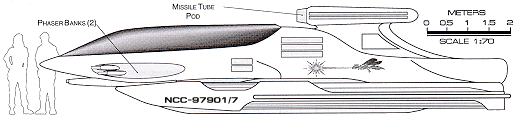 Hornets have very low maintenance requirements. Coronado normally carries
four Hornets in an upper shuttlecraft bay.
Hornets have very low maintenance requirements. Coronado normally carries
four Hornets in an upper shuttlecraft bay.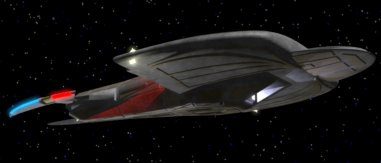 Kelaka was originally conceived to augment Coro's exploratory and tactical
functions, while providing an information-gathering platform that could gather detailed
information from a distance without relying on active sensing systems that could potentially
give away its position. While the full extent of the equipment aboard Kelaka has
not been disclosed by the design team members, we believe she is extremely well
outfitted for covert operations.
Kelaka was originally conceived to augment Coro's exploratory and tactical
functions, while providing an information-gathering platform that could gather detailed
information from a distance without relying on active sensing systems that could potentially
give away its position. While the full extent of the equipment aboard Kelaka has
not been disclosed by the design team members, we believe she is extremely well
outfitted for covert operations.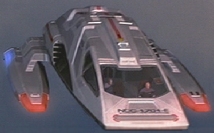 Coronado carries a pair of Minervas, informally known as Diana and Teresa.
While Minervas can be fitted with the same detachable modules that were previously carried
by Danube class runabouts, Coro only has one such module aboard: a weapons/sensor
relay module. With this module in place, a Minerva can act as an armed sensor relay pod for
Coronado, increasing her sensor range. Minervas are also fitted with medium-duty
shields, three type VIII phasers (two forward, one aft; maximum output 4,200 kW), and a
microtorpedo sling. The Minerva class shuttle should be in general use for some time to come!
Coronado carries a pair of Minervas, informally known as Diana and Teresa.
While Minervas can be fitted with the same detachable modules that were previously carried
by Danube class runabouts, Coro only has one such module aboard: a weapons/sensor
relay module. With this module in place, a Minerva can act as an armed sensor relay pod for
Coronado, increasing her sensor range. Minervas are also fitted with medium-duty
shields, three type VIII phasers (two forward, one aft; maximum output 4,200 kW), and a
microtorpedo sling. The Minerva class shuttle should be in general use for some time to come! In practice, the use of slipstream technology was problematic. Although
short-lived conduits could be generated relatively easily, a major problem plagued the
project: quantum phase variances. During the transit, these variances had a tendency
to disrupt the conduit, overloading the quantum bubble and prematurely dropping the
starship out of slipstream, with disastrous results. Several successful tests were
conducted in 2386, but they were done with vessel sizes no greater than about 16 meters long.
In practice, the use of slipstream technology was problematic. Although
short-lived conduits could be generated relatively easily, a major problem plagued the
project: quantum phase variances. During the transit, these variances had a tendency
to disrupt the conduit, overloading the quantum bubble and prematurely dropping the
starship out of slipstream, with disastrous results. Several successful tests were
conducted in 2386, but they were done with vessel sizes no greater than about 16 meters long.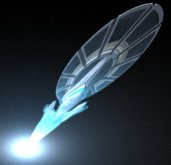 The Katana class starship is the first Starfleet design specifically built
around the quantum phase inversion propulsion technology. The major advantage to the class,
of course, is its multi-mission capability. Though a relatively small ship, the Katana
class frigates should provide a suitable testbed on which to refine slipstream further.
Already, though, several drawbacks to this propulsion technology have been identified.
First, as stated above, the phase variances of the matrix need to be carefully monitored at
all times. Failure to do so could result in the matrix overloading and the vessel dropping
out of the conduit unexpectedly. Second, only low energy deflectors may be used during
transit: high energy deflectors will disrupt the matrix or prevent its formation entirely.
The Katana class starship is the first Starfleet design specifically built
around the quantum phase inversion propulsion technology. The major advantage to the class,
of course, is its multi-mission capability. Though a relatively small ship, the Katana
class frigates should provide a suitable testbed on which to refine slipstream further.
Already, though, several drawbacks to this propulsion technology have been identified.
First, as stated above, the phase variances of the matrix need to be carefully monitored at
all times. Failure to do so could result in the matrix overloading and the vessel dropping
out of the conduit unexpectedly. Second, only low energy deflectors may be used during
transit: high energy deflectors will disrupt the matrix or prevent its formation entirely. The Spectre is a one-person space/atmospheric control fighter. Quite maneuverable
at sublight, the ship is fitted with both the gravimetric propulsion system used in
shuttlecraft and a micro-impulse engine. It carries medium-duty shields, and is armed
with a pair of pulse phaser cannons on each wing (maximum output 33.0 MW), as well as
a micro-torpedo sling on the ventral side with a complement of 100 launch-ready quantum
micro-torpedoes. The Spectre is capable of sustained speeds of warp 7, or burst speeds
exceeding warp 9. Lacking a bulky warpcore, plasma conduits, or nacelles, the Spectre
is lightweight, making it uniquely maneuverable and survivable.
The Spectre is a one-person space/atmospheric control fighter. Quite maneuverable
at sublight, the ship is fitted with both the gravimetric propulsion system used in
shuttlecraft and a micro-impulse engine. It carries medium-duty shields, and is armed
with a pair of pulse phaser cannons on each wing (maximum output 33.0 MW), as well as
a micro-torpedo sling on the ventral side with a complement of 100 launch-ready quantum
micro-torpedoes. The Spectre is capable of sustained speeds of warp 7, or burst speeds
exceeding warp 9. Lacking a bulky warpcore, plasma conduits, or nacelles, the Spectre
is lightweight, making it uniquely maneuverable and survivable. Called "Condition Blue" or "Blue Alert," the call to land on a planetary surface must come
from the ship's commanding officer. Once that is done, plasma is vented from the warp
nacelles, structural integrity and inertial dampers are set to maximum, and emergency power
is routed to reaction control thrusters and impulse systems. Generally, the shields (if
available) are also reconfigured for a flight dynamics protocol to ease the transition from
the in-space to in-atmosphere environment.
Called "Condition Blue" or "Blue Alert," the call to land on a planetary surface must come
from the ship's commanding officer. Once that is done, plasma is vented from the warp
nacelles, structural integrity and inertial dampers are set to maximum, and emergency power
is routed to reaction control thrusters and impulse systems. Generally, the shields (if
available) are also reconfigured for a flight dynamics protocol to ease the transition from
the in-space to in-atmosphere environment. © Copyright 2003,