
Kelaka, Overview and Introduction
Everything about Kelaka is designed to make her as efficient as possible.
For those unfamiliar with the Cardassian language (Varagasi), the term
"Kelaka" means dragonhound, a canine-like animal native to Cardassia. If
she were classified as a specific type of kelakin, she'd be an albrevlak.
Albrevlak are small, but extremely stubborn and feisty. Sounds rather
appropriate, don't you think? In any case, Kelaka, though small, is one
of the most capable vessels in the quadrant.
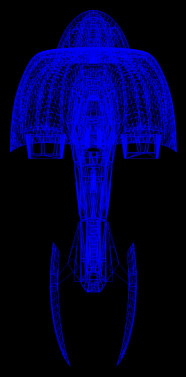 Equipped with a fairly fast warp system for her size, a powerful impulse manifolds
coupled to an extremely reliable IDF system, a respectable weapons array, excellent defensive
systems, and perhaps the most powerful computer for its size, Kelaka is
capable of giving most starships a run for their money, in terms of capability vs.
size. She's designed to be crewed by three-a helmsman, a tactical operator, and
sensor operator, and has the capacity for up to nine additional personnel.
Equipped with a fairly fast warp system for her size, a powerful impulse manifolds
coupled to an extremely reliable IDF system, a respectable weapons array, excellent defensive
systems, and perhaps the most powerful computer for its size, Kelaka is
capable of giving most starships a run for their money, in terms of capability vs.
size. She's designed to be crewed by three-a helmsman, a tactical operator, and
sensor operator, and has the capacity for up to nine additional personnel.
I designed the initial spaceframe of Kelaka, which was then further tweaked by Miss Oswald and Mister Daren. Mister Daren, with assistance from myself, implemented the weapons systems and a number of the defenses, while Miss Oswald handled the ships extremely advanced sensor arrays. I personally built the computer core. I realize many prefer not to get technical, but as a brief note, Coronado's cores have an average access rate to storage size ratio of 1:412. Kelaka has a ratio of 1:30, not to mention a faster access rate. I'm rather proud of that. Additionally, Kelaka's systems are literally unassailable in terms of attempting to take them over. Even an assimilation attempt by the Borg wouldn't make it through the aggressive defensive systems Kelaka has installed in her core. Anyhow, back on topic. It took us about five months to build her, mostly due to the fact that we couldn't get the necessary Cardassian hull and weapon components for some time. Her first mission was a rescue mission to retrieve Ka'tek vestai'Kharas from the surface of a rather curious world whose inhabitants possessed magic-like abilities. She performed beautifully, and even managed to perform several thousand g-force maneuvers in an atmosphere. Naturally, that's nothing to the several million starships undergo when accelerating to full impulse, but it's quite impressive for atmospheric conditions.
On Flight Performance
Kelaka has one of the most amazing flight performance profiles of any ship
I've ever seen. She's much smaller than the smallest Cardassian combat vessels
(the Hideki-class Scouts), and really fits the profile of Captain's Yacht or heavy
runabout quite well. However, she's got the maneuvering capacity approaching that
of a Spectre, which makes her that much more impressive. Naturally, she can't
match the Spectres' ability to "side-step" with their gravimetric drives, but as
far standard impulse flight maneuvers, she's hard to beat.
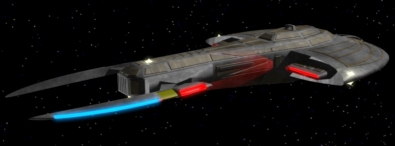 Her ability to perform such incredible maneuvers comes from her impulse manifolds.
Kelaka, like any vessel, has a standard compliment of RCS (Reaction Control
System) thrusters for precision maneuvering at low velocities. But her impulse
system is a lot heftier. Kelaka's impulse manifolds are capable immense
output, due to their relatively large size in comparison with Kelaka's
total mass.
Her ability to perform such incredible maneuvers comes from her impulse manifolds.
Kelaka, like any vessel, has a standard compliment of RCS (Reaction Control
System) thrusters for precision maneuvering at low velocities. But her impulse
system is a lot heftier. Kelaka's impulse manifolds are capable immense
output, due to their relatively large size in comparison with Kelaka's
total mass.
This, coupled with the fact that both have a 45° directional swivel and the simple fact that there are two of them allow Kelaka to use both like massive directional thrusters. In short, Kelaka doesn't even need to consider her RCS thrusters once she leaves dock. Once in the open, Kelaka can perform maneuvers that would tear the hull plating off of any starship that tried them. This also due to her very redundant IDF and SIF systems, both created by Miss Oswald. I think she really built them with me in mind, since I've been known to push Coronado beyond her limits in terms of maneuvers.
As for warp performance, Kelaka is also fairly impressive. So far, the shuttle-size vessel holding the record for speed is Voyager's Delta Flyer, at a sustainable warp cruiser of six-point-eight. Kelaka can sustain warp eight, and even travel at warp nine-point-two for up to thirty minutes. This is largely due to her variable-geometry nacelles. Practically speaking, Kelaka is extremely inconvenient to store, so her nacelles would need to be very close to the hull. As seen on the Defiant-class design, close nacelles are often detrimental to warp flight capability. To combat this, Kelaka's warp nacelles are capable of retracting towards the hull for docking configuration and extending outward for warp flight. In their extended mode, they have an incredibly efficient warp field geometry, allowing Kelaka to achieve otherwise unattainable speeds for a vessel of her size.
Tactically Speaking
For a vessel of her size, Kelaka has a fairly impressive armament. Her
primary weapon is a redundant-emitter spiral-wave disruptor, a standard Cardassian
weapon that doubles as a navigational deflector. The main array, as it's usually
referred to, has a maximum output of 28 megawatts, which is equivalent to a
three-emitter Type XII starship phaser array. While not a major threat to large
capital ships, in terms of space superiority combat between shuttles or fighters,
her forward-firing array would allow her to largely dominate the field.
Supporting the main array are several smaller, individual spiral-wave disruptors in the traditional pyramidal shape. These emitters each have an output of 9.3 MW, which is greater than a Type XII phaser emitter. Kelaka possesses six of these-four on the wing blades (one on each corner, dorsal and ventral), one between the warp nacelle mounts on the dorsal surface of the fuselage, and one just below the primary exhaust vents on the ventral surface.
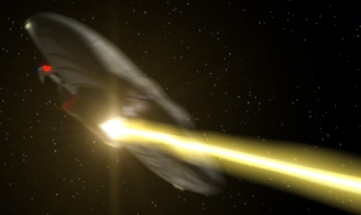 Kelaka has an additional beam weapon system that was installed with
Coronado's Marines in mind. On either side of the fuselage are two
anti-personnel/anti-armor phaser arrays. While useless in terms of ship combat,
these arrays are more than enough to halt advancing forces and deal damage to any
armored vehicles or emplacements they may be using. Unfortunately, Kelaka
is a small vessel, and suffers from the power restrictions of small vessels.
Kelaka is only able to fire either her main array or her secondary arrays
in tandem with the anti-personnel weapons. In other words, her weapons
configuration can either be 1-3 or 2-3, but not 1-2.
Kelaka has an additional beam weapon system that was installed with
Coronado's Marines in mind. On either side of the fuselage are two
anti-personnel/anti-armor phaser arrays. While useless in terms of ship combat,
these arrays are more than enough to halt advancing forces and deal damage to any
armored vehicles or emplacements they may be using. Unfortunately, Kelaka
is a small vessel, and suffers from the power restrictions of small vessels.
Kelaka is only able to fire either her main array or her secondary arrays
in tandem with the anti-personnel weapons. In other words, her weapons
configuration can either be 1-3 or 2-3, but not 1-2.
Fortunately, when Mr. Daren told me of this, I wrote a subroutine into the computer core that told Kelaka to automatically switch to 2-3 mode when the main array wasn't actually in use. Kelaka can switch between modes in 50 milliseconds, so performance degradation is minimal. Kelaka also has a fairly respectable shield system. While only 15% of Coronado's shield system, Kelaka's shields do exceed those found aboard the Spectres by 14%, which is something to note. Spectres are designed for combat, whereas Kelaka is designed more as an independent mission support craft. The fact that her shields exceed those of a combat vessel is out of the ordinary, to say the least. Augmenting the shields is a rather unique ablative armor matrix. Ever since its first real introduction aboard the Defiant-class, ablative armor has quickly become the standard for Starfleet vessels. Kelaka, however, doesn't use the standard carbon-carbon ablative armor matrix. Instead, the carbon-carbon matrix has been augmented with toranium, a standard and highly durable Cardassian construction material that's fairly unique to Cardassian space. This combination armor makes Kelaka much tougher than most similarly outfitted vessels.
And, last but most certainly not least, we must discuss Kelaka's stealth systems. Now, I've made no secret of the fact that I was formerly part of the Obsidian Order. It's also no secret that we of the Order enjoy moving quietly. Kelaka does that with amazing efficiency. We managed to procure a Romulan shroud system for her. While not exactly as efficient as a full-bore cloaking device, the shroud does completely conceal Kelaka from visual/optical scans by refracting the local spatial conditions around her and making her blend in with her surroundings. While this is largely what a cloaking device does, the cloaking device takes it further and basically completely refracts the entire visual and most of the subspace spectrum. Since the shroud doesn't do this, I've taken the liberty of installing a few additional safety measures. Kelaka is capable of almost completely locking down her emissions, but electronic and otherwise. I've also minimized her sensor profile so about ninety-seven percent of all scans directed at her will show nothing but normal space. We had the chance to use this on Kelaka's first mission, and I found it rather amusing to watch the locals mill about not ten meters away, without a clue that a state-of-the-art vessel had its weapons fixed on them.
Knowledge is Power
It's also no secret that, while with the Order, I specialized in code slicing
and breaking into highly defended systems. I know, better than anyone, how
susceptible a vessel can be to such a form of aggression. In seconds, a
mighty battleship can be rendered inoperative, simply by knowing the right
things to manipulate. Now, as I mentioned, I personally designed
Kelaka's computer core. As such, it's probably the most well defended
computer system in the entire quadrant. I highly doubt even years of work by
the Borg could break into the system. The outermost defensive layers are
sets of aggressive programs. The second they see something they don't have
on their approved list, they query it. If it doesn't give the correct
responses, they go in and tear the code apart. It's actually rather vicious.
To test it, I wrote a fairly cover and secretive program that was also
employed one of the best defensive codes I had ever written. The system took
all of six seconds to break through the defenses and completely annihilate
the program. Additionally, if a program attempts to invade and then retreats,
the system is designed to pursue it, if possible, and track it back to its
source.
I won't go into detail, but the general layout of Kelaka's computational defenses goes something like this. The outermost layers consist of aggressive programs designed to seek out invasive attempts and destroy them. The next layer is a straight-out detection layer, designed to alert the inner defenses of anything that did manage to slip through the cracks (a piggy-backed signal, for example). Ready to come at a moment's notice is a second batch of aggressive programs ready to tear apart whatever got in. On the off chance that something can run through the system faster than those programs can reach it, there's an additional batch of defensive layers designed entirely at repulsion, not attack. They basically block out anything from coming in and wait for the above layers to come and erase it. There are several more layer batches, but I can't reveal all my secrets, now can I? Everything runs on varying fractal encryption codes, so if one of the defensive programs goes down, it doesn't tell anything about how the others work.
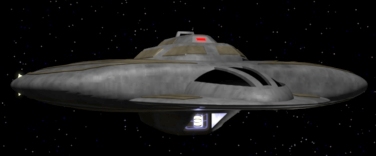 In short, as mentioned, Kelaka is unassailable. Now, here's the fun
part. Kelaka works both ways. Anything she can use for defense, she
also has available for attack. Coupled with her extremely fast speed,
Kelaka can break into virtually any system in short order without
tripping any alarms and get out just as fast. On the chance that something
does find Kelaka and try to counter-slice Kelaka's systems, it's
ripped apart by the defenses. A fairly…vicious arrangement, wouldn't you say?
Much like Nature herself, in all her vicious, natural glory.
In short, as mentioned, Kelaka is unassailable. Now, here's the fun
part. Kelaka works both ways. Anything she can use for defense, she
also has available for attack. Coupled with her extremely fast speed,
Kelaka can break into virtually any system in short order without
tripping any alarms and get out just as fast. On the chance that something
does find Kelaka and try to counter-slice Kelaka's systems, it's
ripped apart by the defenses. A fairly…vicious arrangement, wouldn't you say?
Much like Nature herself, in all her vicious, natural glory.
We've been working with Savant, Coronado's sentient holographic liaison to strengthen defenses even further. The system knows not to totally erase Savant, so any attempt Savant makes to get in that the system notices immediately jumps on Savant's current program and tears it apart. Fortunately, Savant constantly backs up her program, so she never gets lost. The point of these exercises is to see if there's anything I may have forgotten-any back doors that I left open. Savant has a great deal of experience in this field, much as I do, and I am quite thankful for her help in these matters.
In Conclusion
There's a great deal more to know about Kelaka, but that would ruin all
the fun, now wouldn't it? For now, we'll leave it at that. I am, naturally,
always available during my off-duty time for anyone who wishes to know more
about Kelaka than what's contained in this document, but just because
you ask doesn't necessarily mean I'll answer; there are some things people just
shouldn't know about what all Kelaka can do. Oh, and one brief, final
note: don't try to physically break into Kelaka. Remember those
anti-personnel phasers I told you about? They certainly can clear the head!

Once you're done here, tap Back to return to the Coronado information index or the Return key at the bottom of your PADD, and you will be returned to the main index.





 © Copyright 2002,