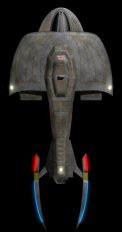
 Forward control section, main fuselage, wing blades
15.3 m / 4.7 m
Tri-layer suspension "sandwich" with self-breach-sealing capabilitiesStandard compliment: pilot, tactical operator, sciences operatorClass H through M environments sustainable
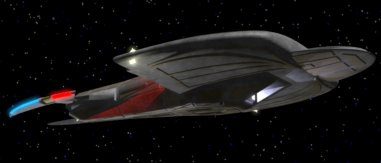 Incorporating a mix of Federation, Cardassian, and Rihannsu technology, Kelaka
was inspired by the large, high-speed bombers used by the Rihannsu fleet and was constructed by a
team aboard U.S.S. Coronado by Commander Fornan Dejat, Lt. Commander William Daren, and Lt.
Zunite Oswald. Commander Dejat provided the basic design principles, including the Cardassian
profile and weapons technologies used.LCARS interface program matrix (version beta-A3)
Incorporating a mix of Federation, Cardassian, and Rihannsu technology, Kelaka
was inspired by the large, high-speed bombers used by the Rihannsu fleet and was constructed by a
team aboard U.S.S. Coronado by Commander Fornan Dejat, Lt. Commander William Daren, and Lt.
Zunite Oswald. Commander Dejat provided the basic design principles, including the Cardassian
profile and weapons technologies used.LCARS interface program matrix (version beta-A3)Experimental bioneural geldisk faster-than-light core elements
Bio-neural geldisks (phase beta-2)
Phase-replication of main core and subprocessors
Cryogenic deuterium matrix subspace field propulsion systemPlasma exhaust impulse-fusion system with space-time driver coil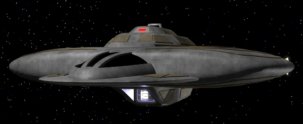 Kelaka (the name translates roughly as "dragonhound" and refers to a creature native to
Cardassia Prime) was intended as a heavier, runabout-size alternative to Coronado's
rather small shuttlecraft. With a normal crew of three, the ship can carry and sleep up to 12
people and can be used to conduct on-site sensor scans and research away from Coro. The
ship is quite survivable under a variety of conditions.Peak momentary load:Maximum recharge rate:
Kelaka (the name translates roughly as "dragonhound" and refers to a creature native to
Cardassia Prime) was intended as a heavier, runabout-size alternative to Coronado's
rather small shuttlecraft. With a normal crew of three, the ship can carry and sleep up to 12
people and can be used to conduct on-site sensor scans and research away from Coro. The
ship is quite survivable under a variety of conditions.Peak momentary load:Maximum recharge rate:Wing blades ventral (two)
Maximum emitter output:Emitter locations:Maximum emitter output:Emitter locations:Wing blades ventral, port and starbaord
Aft fuselage, ventral and dorsal
Micro-torpedo slings mounted fore and aftLauncher location:Quantum torpedoes: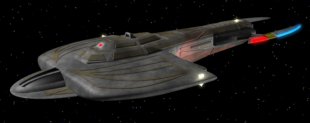 Inspired by Rihannsu technology, Kelaka incorporates a highly advanced
stealthing system referred to by the Rihannsu as the "shroud." Similar to Federation holographic
defense technology, a shrouded ship can artificially lower its EM output to near space-background
levels and disguise itself as part of the surrounding environment or another ship, or anything
at all... The ship also includes a highly advanced ECM suite.Incorporates a Rihannsu shrouding defense systemProjection range:Emitter locations:
Inspired by Rihannsu technology, Kelaka incorporates a highly advanced
stealthing system referred to by the Rihannsu as the "shroud." Similar to Federation holographic
defense technology, a shrouded ship can artificially lower its EM output to near space-background
levels and disguise itself as part of the surrounding environment or another ship, or anything
at all... The ship also includes a highly advanced ECM suite.Incorporates a Rihannsu shrouding defense systemProjection range:Emitter locations:Fuselage dorsal and ventral
Redundant medium-power graviton polarity source generatorsCenter ventral
Narrow-angle active EM scanner
Pinpoint active EM scanner
Variable frequency EM flux sensor
Lifeform analysis instrument cluster
Parametric subspace field stress sensor
Gravimetric distortion scanner
Thermal imaging array
Proximity sensor array type 11-A
Secondary: Aft center dorsal
Wide-angle IR Source Tracker
Narrow-angle IR-UV-gamma Ray Imager
Stellar graviton detectors
High-Energy charged particle detectors
Federation timebase beacon receiver
Impulse time distortion corrector
Secondary: Cockpit module
Pallet 1:Active magnetic interferometry scanner
Gravimetric distortion mapping scanner
Pallet 2:Pinpoint EM flux sensor
Weapons and sensor targeting scanner
ACB relay booster array
Pallet 3:Localized subspace field stress sensor
Parametric subspace field stress sensor
Low-level thermal imaging sensor
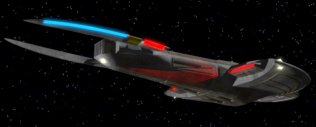 Kelaka's nacelles are mounted on variable geometry struts, and like most Captain's yachts,
can retract for storage. In addition to her Cardassian-inspired weaponry and Rihannsu-inspired
defenses, Kelaka includes some of the finest sensors Federation technology has
to offer, including sensors usually only found on a much larger ship. Like all Starfleet
support craft, she also includes transporter capability.Includes medium-power Emergency Evac System micro-transporter clusterCapacity:Capacity:Pilot:
Kelaka's nacelles are mounted on variable geometry struts, and like most Captain's yachts,
can retract for storage. In addition to her Cardassian-inspired weaponry and Rihannsu-inspired
defenses, Kelaka includes some of the finest sensors Federation technology has
to offer, including sensors usually only found on a much larger ship. Like all Starfleet
support craft, she also includes transporter capability.Includes medium-power Emergency Evac System micro-transporter clusterCapacity:Capacity:Pilot:Manual navigation
Attitude control
Position verification
Reaction control systems
Communications control
Access to all Tactical systems
Tactical:Weapons control
Defensive assessment
Priority/resource/power allocation
General status information
Access to all Science systems
Science:Realtime data feed from damage detection sensors
General status information
Access to all Tactical systems





 © Copyright 2002,