
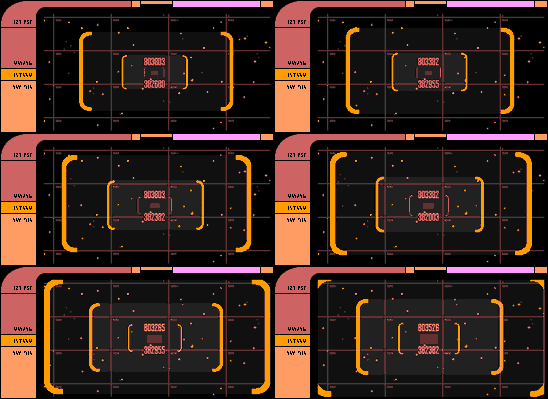
 20 light-years has been the standard maximum range for most sensors of this
type: at ranges longer than this, the pulse return time and the energy
requirements become excessive. It is possible to extend the range of
standard sensors by diverting more energy into the unit, which will give a
longer possible range. However, the warp 9.9997 speed remains a constant --
therefore, even if the range is increased 50%, to 30 light-years, the time for
the pulse to travel the distance, reflect off an object, and return will be
three hours, 50% more than the time to scan out to 20 light-years range.
20 light-years has been the standard maximum range for most sensors of this
type: at ranges longer than this, the pulse return time and the energy
requirements become excessive. It is possible to extend the range of
standard sensors by diverting more energy into the unit, which will give a
longer possible range. However, the warp 9.9997 speed remains a constant --
therefore, even if the range is increased 50%, to 30 light-years, the time for
the pulse to travel the distance, reflect off an object, and return will be
three hours, 50% more than the time to scan out to 20 light-years range.
Higher rates of return information require that the pulse width be widened, resulting in higher resolution, but reduced range. In a standard sensor array, high-resolution return of information is only available to approximately 7 light-years, though again this range can be increased by greatly increasing the energy budget.
The LORASON sensor array utilizes the same energy budget as standard sensors, but directs the active scanning pulse through a series of postprocessors based on a cryogenic dilithium matrix. The same matrix that allows a starship to increase its speed by a factor of between three and ten has been found to have nearly the same effect on the subspace scanning pulse, increasing its speed to warp 9.99997. This results in a nominal return of information at a range of nearly 60 light-years, with an identical pulse travel time. A LORASON sensor pulse takes one hour to travel 60 light-years, reflect off an object, and return. Similarly, high resolution sensor information also enjoys a three-fold increased range, to 21 light-years.
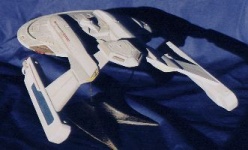 Until now, LORASON sensor arrays and their high-energy postprocessing
systems have had specialized power and storage requirements. This has
required that they be mounted only on dedicated platforms, or dedicated
modules available only for Nebula, Akira, and Eclipse class starships.
However, miniturization work done by Whitestone Enterprises has benefitted
the LORASON technology such that it can now be mounted internally within
most classes of Starfleet vessels, though the postprocessing array must
still be mounted externally over the upper and lower portions of the
deflector dish.
Until now, LORASON sensor arrays and their high-energy postprocessing
systems have had specialized power and storage requirements. This has
required that they be mounted only on dedicated platforms, or dedicated
modules available only for Nebula, Akira, and Eclipse class starships.
However, miniturization work done by Whitestone Enterprises has benefitted
the LORASON technology such that it can now be mounted internally within
most classes of Starfleet vessels, though the postprocessing array must
still be mounted externally over the upper and lower portions of the
deflector dish.
Because of this, LORASON systems may not be used on vessels mounting high-power deflector systems. The LORASON postprocessors will prevent deflector output from rising over approximately 4,800 megawatts total power. The use of the array requires that the postprocessing system be mounted externally over the deflector array, and its mass and complexity prevents removal or retraction, except at a Starbase or similar facility.
Similarly, much like the AWACS aircraft of 20th century Earth, a starship mounting the LORASON system advertises its presence over a very wide area, even when the system is not energized. As a result, a ship mounting the LORASON system may not use a cloaking device or other stealthing system when the LORASON postprocessors are mounted. Removing the postprocessors (and thus disabling the LORASON array) allows a cloak or other stealthing system to be used normally.
Despite these disadvantages, the LORASON system provides tremendous advantages in the area of exploration, research, and tactical command and control. An explorer mounting the LORASON technology becomes the ultimate charting and mapping platform, with vision spanning more than 11,000 cubic light-years, nearly ten times the scanning area of a ship not so equipped. A high-speed command and control ship mounting the LORASON system allows tactical commanders to direct the activities of dozens of starships across the same area of space, giving a tremendous strategic advantage.
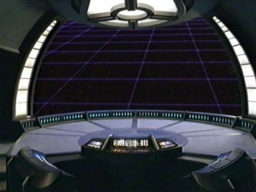 When combined with an Astrometrics Lab and associated Tactical Analysis
Labs, the tactical uses of LORASON become simply stunning. These allow a
tactical commander to enter a three-dimensional holographic environment
displaying the total information output of not only LORASON-equipped ships
and platforms in the area, but ships mounting standard sensors as well.
Similar to the "Combat Information Centers" of 20th century Earth, these
"Command Information Centers" are currently being constructed in selected
Starfleet command and control ships. Unfortunately, because of the
restrictions on deflector shield output forced by the LORASON
postprocessors, Starfleet Starbases are not currently being considered for
the technology, though several Starbases are beginning construction of
dedicated LORASON sensor platforms within their defensive perimeters.
When combined with an Astrometrics Lab and associated Tactical Analysis
Labs, the tactical uses of LORASON become simply stunning. These allow a
tactical commander to enter a three-dimensional holographic environment
displaying the total information output of not only LORASON-equipped ships
and platforms in the area, but ships mounting standard sensors as well.
Similar to the "Combat Information Centers" of 20th century Earth, these
"Command Information Centers" are currently being constructed in selected
Starfleet command and control ships. Unfortunately, because of the
restrictions on deflector shield output forced by the LORASON
postprocessors, Starfleet Starbases are not currently being considered for
the technology, though several Starbases are beginning construction of
dedicated LORASON sensor platforms within their defensive perimeters.
With the expansion enjoyed by the UFP in recent years and the greatly increased area that must be explored and defended by Starfleet, the utility of the LORASON platform becomes plain.
Once you're done here, tap Back to return to the Coronado information index or the Return key at the bottom of your PADD, and you will be returned to the main index.





 © Copyright 2002,