
| Technical Specifications on U.S.S. Coronado | |||
| U.S.S. Coronado, NCC-97901 | |||
| Katana Class Frigate |  | ||
| Sister ships: | U.S.S. Renegade, NCC-97902 U.S.S. Hunter, NCC-97903 U.S.S. Saratoga, NCC-97904 11 others plus 49 planned | ||
| Commissioned: | Stardate 239903.07 | ||
| Construction site: | |||
| Design life: | 36 years | ||
| DIMENSIONS: | |||
| Saucer Primary Hull, Secondary Engineering Hull Two Warp Nacelles with Variable Geometry Struts Eight Detachable Saucer Module Segments | |||
| Length / Width / Draft: | 415 m / 254 m / 60m | ||
| Standard cruise mass: | 1.4 million metric tonnes | ||
| Number of decks: | 22 (Saucer: 11; Secondary: 16) | ||
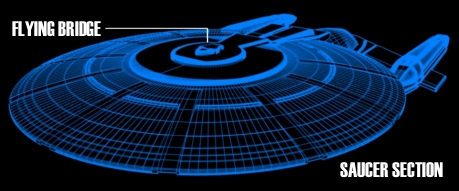
U.S.S. Coronado, like all Katana class starships, has a saucer section, a engineering section, and two warp nacelles mounted on variable geometry struts. Note the eight detachable saucer sections -- these allow the Katana class ships to be reconfigured for multiple mission profiles. | |||
| HULL: | |||
| Three layer suspension "sandwich" with self-breach-sealing capabilities | |||
| Outer layer: | Carbon-carbon ablative armor matrix | ||
| Middle layer: | Self-sealing tripolymer/duranium suspension gel | ||
| Inner layer: | Tetroburnium/duranium alloy | ||
| ENVIRONMENT: | |||
| Standard crew compliment of 215 officers and crew, 274 Marines Able to sustain up to 825 personnel; Class H-N environments | |||
| Class H/K environments: | Sustainable for 150 persons maximum | ||
| Class L environment: | Sustainable for 50 persons maximum | ||
| Class M environment: | Sustainable indefinitely | ||
| Class N environment: | Sustainable for 30 persons maximum, only in Shuttlebays | ||
| COMPUTER: | |||
| LCARS II biometic composite program matrix | |||
| Main core location: | Decks 4 through 8, saucer | ||
| Secondary core locations: | Decks 16 through 18, engineering | ||
| Hardware/software design: | Biometic and bioneural matrix circuitry, Phase-replication of main, secondary cores | ||
| Data transfer rate: | 5,110 kiloquads / second | ||
| Maximum storage capacity: | 2,106,312 megaquads average | ||
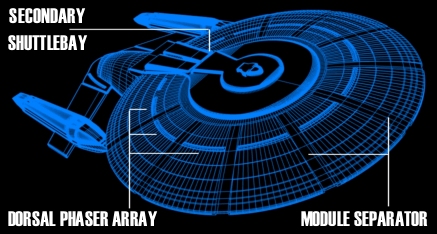
Coronado's primary Type XII phasers are mounted on both the dorsal and ventral sides of the removable saucer modules, the collimators in each module linked through biometric circuitry and EPS conduits to the modules on either side. Critical systems are protected by carbon-carbon ablative armor. Each saucer module is an replacable unit, linked to adjacent modules by structural braces, corridors, power, and data systems. | |||
| PROPULSION/EXPERIMENTAL: | |||
| Experimental Quantum Phase Inversion ("Slipstream") propulsion Slipstream speed is greatly dependent on local subspace field densities | |||
| Sustainable cruise: | Variable; warp 9.9 through 9.99992, equivalent | ||
| Emergency speed: | Not applicable; see Tech Info | ||
| PROPULSION/HYPERLIGHT: | |||
| Matter/Antimatter Reaction propulsion, Variable Warp Field Geometry | |||
| Sustainable warp cruise: | Warp 9.6 | ||
| Emergency speed: | Warp 9.975, for up to 8 hours | ||
| PROPULSION/SUBLIGHT: | |||
| Tandem impulse/fusion reactor system, Reaction Control Thrusters | |||
| 0.25 c | |||
| Emergency speed: | 0.75 c | ||
| TACTICAL/SHIELDS: | |||
| Incorporates regenerative shielding technology | |||
| Number of field generators: | 12 | ||
| Sustainable load: | 4,210 MW | ||
| Peak momentary load: | 6,550 MW for 220 ms | ||
| Maximum recharge rate: | 72.2 MW/s | ||
| Field generator locations: | Deck 2 (one), Deck 5 (two), Deck 9 (three), Deck 15 (four), Deck 19 (two) | ||
| Auxiliary systems output: | 80% of primary | ||
| TACTICAL/PHASERS: | |||
| Incorporates Starfleet-standard phaser emitter force recoupling | |||
| Number of emitters: | 10 | ||
| Main phaser arrays: | 2 Type XII | ||
| Maximum emitter output: | 8.4 MW per emitter | ||
| Emitter locations: | Saucer section, dorsal and ventral (180 segments) | ||
| Secondary phaser arrays: | 7 Type XI | ||
| Maximum emitter output: | 6.4 MW per emitter | ||
| Emitter locations: | Shuttlebay dorsal, port and starboard (60 segments) Engineering fore ventral, center (50 segments) Nacelle struts ventral, port and starboard (25 segments) Saucer aft dorsal, port and starboard (15 segments) | ||
 | |||
| TACTICAL/TORPEDOES: | |||
| Incorporates experimental false matter torpedoes and launchers | |||
| Torpedo types: | Experimental False Matter Munitions Standard Quantum Anti-Ship Torpedoes Standard Cluster Anti-Fighter Torpedoes | ||
| Torpedo launchers: | 3 (2 forward, 1 aft) | ||
| Launcher location: | Saucer, deck 9 forward (two) Engineering, deck 16 aft | ||
| Torpedo load-out: | 160 casings and warheads | ||
| False matter torpedoes: | 20 (20 launch-ready, 0 stored) | ||
| Quantum torpedoes: | 100 (30 launch-ready, 70 stored) | ||
| Cluster torpedoes: | 40 (20 launch-ready, 20 stored) | ||
| Maximum volley / launcher: | 1 false matter or 5 standard torpedoes per launcher | ||
| TACTICAL/EXPERIMENTAL: | |||
| Incorporoates the experimental external holographic defense system | |||
| Holographic Defense System: | 6 emitters | ||
| Emitter function: | Two images to a maximum range of 25,000 km | ||
| Emitter locations: | Deck 3 (two), Deck 9 (two), Deck 20 (two) | ||
| Heavy Graviton "Lance": | 1 emitter | ||
| Maximum emitter output: | 3,105 MW One 10-second burst per 2 hour charge | ||
| Emitter location: | Main deflector dish, deck 15 | ||
| NAVIGATIONAL DEFLECTOR: | |||
| Redundant high-power graviton polarity source generators | |||
| Number of emitters: | 3 | ||
| Emitter locations: | Engineering, deck 17 | ||
| SENSORS/LONG RANGE: | |||
| Incorporates the experimental LORASON science/tactical sensor array cluster | |||
| Emitter location: | Behind main deflector array Engineering, deck 16 | ||
| High resolution mode range: | 21 light years | ||
| Low resolution mode range: | 63 light years | ||
| Primary instruments: | Wide-angle active EM scanner Narrow-angle active EM scanner Pinpoint active EM scanner 2.5 meter diameter gamma ray telescope Variable frequency EM flux sensor Lifeform analysis instrument cluster Parametric subspace field stress sensor Gravimetric distortion scanner Active neutrino imaging scanner Thermal imaging array Proximity sensor array type 12-A | ||
| SENSORS/NAVIGATIONAL: | |||
| Number of pallets: | 3 (1 primary, 2 secondary) | ||
| Pallet locations: | Primary: Engineering, deck 12 Secondary: Saucer aft, dorsal and ventral | ||
| Primary instruments: | Quasar telescope Wide-angle IR Source Tracker Narrow-angle IR-UV-Gamma Ray Imager Active subspace multibeacon receiver Stellar graviton detectors High-energy charged particle detectors Galactic plasma wave cartographic processor Federation timebase beacon receiver Impulse time-distortion corrector Stellar pair coordinate imager | ||
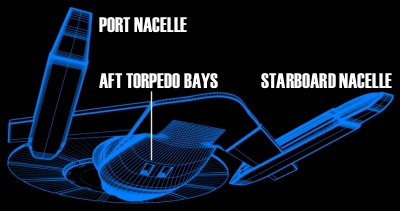
Coronado's warp nacelles are mounted on reverse-angle struts, greatly compressing the ship's Z-angle and by extension, the energy needed for warp or slipstream flight. As a secondary benefit, this compression reduces the necessary size of the starship's shield envelope, giving her and all Katana class starships cruiser-like resilience in a fight. Both fore and aft torpedo launchers and phaser arrays ensure an all-around defense. | |||
| SENSORS/LATERAL: | |||
| Number of arrays: | 8 | ||
| Array locations: | Primary: Lateral edges of the saucer section Secondary: Engineering, deck 17 aft | ||
| Array compositions: | 6 sensor pallet clusters per array | ||
| Pallet 1: | Wide-angle EM radiation imaging scanner Quark population analysis counter Z-range particulate spectrometry sensor | ||
| Pallet 2: | Active magnetic interferometry scanner High-energy proton spectrometry cluster Gravimetric distortion mapping scanner Isometric phase matrix imager | ||
| Pallet 3: | Steerable lifeform analysis instrument cluster Pinpoint EM flux sensor Weapons and sensor targeting scanner ACB relay booster array | ||
| Pallet 4: | Low-frequency EM flux sensor Localized subspace field stress sensor Parametric subspace field stress sensor Hydrogen-filter subspace flux scanner Linear calibration subspace flux sensor | ||
| Pallet 5: | Variable band optical imaging cluster Virtual aperture gravitron flux spectrometer High-resolution graviton flux spectrometer Very low energy graviton spin polarimeter | ||
| Pallet 6: | Active matrix gamma interferometry sensor Low-level thermal imaging sensor Multi-angle gamma frequency counter Virtual particle mapping camera | ||
| SENSORS/OTHER: | |||
| Astrometrics Analysis Lab; Sensor Relay Pods Standard complement of Class I through Class X probes | |||
| Astrometrics Lab: | Deck 9 | ||
| Sensor Relay Pods: | 4 | ||
| Maximum range: | 75 lightyears | ||
| Endurance: | Warp 9.5 for 20 minutes | ||
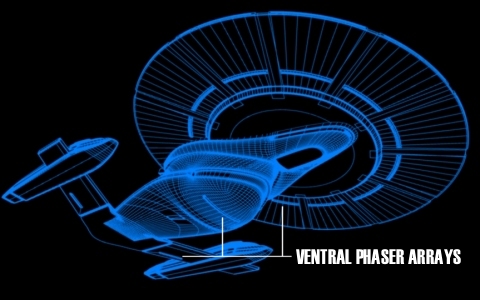
The Katana class was the most extensively modeled starship ever from Utopia Planitia Fleet Yards, starting from a theoretical design nearly 30 years old. In the process, refinements from the last three decades of starship design have been incorporated. The Katana class is quite possibly the single most technologically advanced starship in Starfleet! Endlessly reconfigurable thanks to her modular saucer design, Katana class starships like U.S.S. Coronado should be viable well into the 25th century. | |||
| TRANSPORTERS: | |||
| Does not include the Sickbay microtransporter cluster on Deck 6 Some transporters modified to Apori quantum inversion specifications | |||
| Personnel transporters: | 6 | ||
| Capacity: | 7 persons to 40,000 km | ||
| Locations: | Deck 8, port and starboard (3) Deck 10, port and starboard (3) | ||
| Cargo transporters: | 3 | ||
| Capacity: | 15,000 mt to 40,000 km | ||
| Locations: | Deck 13, in Main shuttlebay Deck 9, in Cargo Bay 1 Deck 18, in Cargo Bay 5 | ||
| Emergency transporters: | 6 | ||
| Capacity: | 20 persons to 15,000 km | ||
| Locations: | Deck 7, port and starboard (2) Deck 12, port and starboard (2) Deck 18, port and starboard (2) | ||
| Assault transporters: | 2 | ||
| Capacity: | 20 persons to 25,000 km | ||
| Locations: | Deck 4, port and starboard | ||
| Transporter emitter pads: | 12 | ||
| AUXILIARY SPACECRAFT: | |||
| Main Shuttlebay: | Decks 12 and 13, aft | ||
| Type 12 warpshuttles: | 2 | ||
| Type 9 cargo shuttles: | 2 | ||
| Spectre-class fighters: | 8 | ||
| Secondary Shuttlebay: | Deck 2, aft | ||
| Type 14 shuttlecraft: | 4 | ||
| Captain's Gig: | Kelaka ("Dragonhound") Deck 11, saucer | ||
| 6-person Lifeboats: | 121, in strategic locations | ||
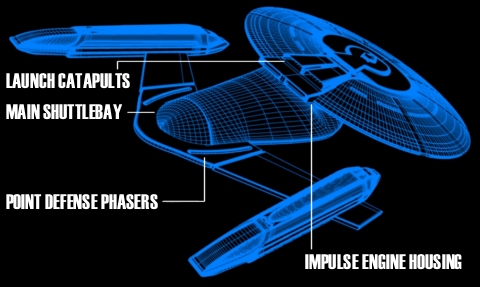
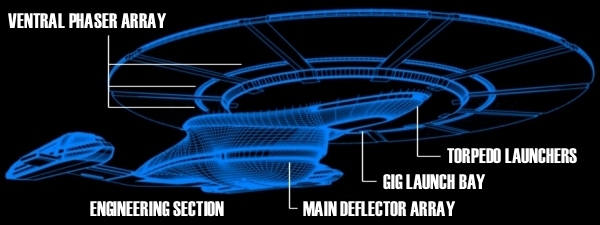
In addition to the traditional aft shuttlebay, Katana class starships include the capability to launch secondary spacecraft from auxiliary bays. Flight Two Katanas such as Coronado also feature a Spectre launch "catapult" just above and forward of the impulse engine housing, allowing the frigate to rapidly deploy fighters in combat situations. Both the main and secondary shuttlebays incorporate point defense phaser arrays also useful against small capital ships. | |||
| HOLODECKS: | |||
| Large holodecks: | 1, on Deck 10 | ||
| Medium holodecks: | 2, on Deck 9 | ||
| Personal holodecks: | 8, on Deck 11 | ||
| MEDICAL: | |||
| Main Sickbay location: | Deck 6 | ||
| Facilities: | 2 intensive care wards 3 surgery suites (includes examination room) 2 physical therapy wards 2 null-grav therapy wards 1 alternative physical therapy ward 3 laboratories CMO's office 13 bio beds Emergency Medical Holographic (EMH) program 1 morgue facility | ||
| Auxiliary Sickbay: | Deck 11 | ||
| ENGINEERING: | |||
| Main Engineering location: | Deck 15 | ||
| Consoles: | Warp propulsion systems status display Impulse propulsion systems status display EPS systems status display Master systems display Master situation monitor Special access systems situation monitor Chief Engineer's Office Duty Engineer's Console Warp core Weapons systems energy allocation console Emergency Engineering Holographic (EEH) program Power distribution console Access to main Jefferies tubes junctions 2 multipurpose command consoles | ||
| Auxiliary Engineering: | Deck 3 | ||
| BRIDGE: | |||
| Antares Shipyards Design; incorporoates the Holographic Projection Viewer | |||
| Main Bridge location: | Deck 9, Section 1 | ||
| Primary Consoles: | 10 | ||
| Flight Ops: | Navigation/course plotting Manual navigation Attitude control Position verification Reaction control systems Bridge liaison to Engineering Priority/resource/power allocation Shuttlecraft operations control General status information | ||
| Tactical I and II: | Shipboard security Starship defense Weapons control Defensive assessment External Holographic Defense System | ||
| Mission Ops: | Away team coordination Marine assault coordination Communications control Electronic Countermeasures (ECM/ECCM) suite control Technology assessment Holographic Projection Viewer control | ||
| Science: | Library computer access Realtime scientific data access Laboratory and sensor coordination Sensor recalibration and reconfiguration All ship's sensors control Mission Ops in absense of the MO officer | ||
| Engineering: | Medium-simplified primary status displays Warp field geometry (when at warp) Special access systems control Engineering status monitoring | ||
| LCARS I and II: | Library computer access Realtime scientific data access Laboratory and sensor coordination Sensor recalibration and reconfiguration | ||
| Environmental: | Critical life support functions Realtime data feed from damage detection sensors Damage team resources allocation Performs scan-lock procedures Main initiator of evacuation sequence | ||
| Auxiliary Bridge: | Deck 1 (The "Flying Bridge") | ||
| Once you're done here, tap Back to return to the Coronado information index or the Return key at the bottom of your PADD, and you will be returned to the main index. | |||
| The U.S.S. Coronado model was created by Ryan McClure. The Katana class design was created by Rick Sternbach, and appeared in the ST:TNG Technical Manual. It was modified for U.S.S. Coronado by Mark Kingsnorth, Fraser Deziel, and Ryan McClure. Reproduction or use of Coronado images in any form is strictly prohibited without the prior written authorization of the site author and digital modeller per this site's terms of use. |





 Star Trek®,
Star Trek: The Next Generation®, Star Trek: Deep Space Nine®, and Star Trek: Voyager®
are registered trademarks of Paramount Pictures
in the United States Patent and Trademark Office. Use of this site constitutes your
acceptance of these terms of use.
Star Trek®,
Star Trek: The Next Generation®, Star Trek: Deep Space Nine®, and Star Trek: Voyager®
are registered trademarks of Paramount Pictures
in the United States Patent and Trademark Office. Use of this site constitutes your
acceptance of these terms of use.
|
 © Copyright 2003,