
Coronado's "Flying Bridge" Module
In late October 2401, the Deck 1 main Bridge module and a significant portion of the saucer of U.S.S. Coronado were destroyed by a Pfhor warship. When the time came to rebuild the ship, it was decided that Coro's rather cramped Bridge would be greatly expanded and moved forward of the Command Information Center on Deck 9. As a result, when the Bridge module was rebuilt, it was not intended to be the primary control center for the frigate, and the controls and capabilities of this new Bridge are somewhat less than the original design.
The original Bridge module aboard U.S.S. Coronado was an extremely advanced design first produced by the Antares shipyards. The latest research in crew efficiency has been incorporated to make this Bridge as effective as possible. In addition, this module incorporates the latest viewer technology, in the form of a Holographic Projection Viewer instead of a viewscreen (sometimes referred to as a holographic "tank").
Since the days of the first upgraded Constitution class vessel, all Federation starships have been equipped with detachable Bridge modules. This allows the bridge station technology to be upgraded as Federation technology advances, prolonging the useful life of the vessel. The only constants from module to module are the Captain's Chair, Helm and Ops stations, and the Tactical Officer's station. Even these change locations frequently. All other stations are designed to reflect the mission of the ship it is installed in and the style of the Commanding Officer.
The Holographic Projection Viewer allows Bridge officers to more easily identify their position relative to multiple objects projected on the viewer. Incorporating the latest in Federation holographic technology, this viewer's advantages are two-fold. First, external views are projected in a holographic space, similar to the operation of the ship's holodecks. This allows the Bridge officers to discern their ship's position relative to objects outside the ship, such as other starships, bases, or planets. Second, when used for communication, the HPV builds a holographic model of the lifeform(s) being communicated with, allowing more efficient communications.
Due to the modifications to the Bridge module as well as the Captain's preference for commanding Coronado from the combined CIC/Bridge facility on Deck 9, the Deck 1 Bridge module is usually referred to as the "Flying Bridge," in honor of the naval warships of earlier eras. The Flying Bridge, like the Bridge/CIC, is continuously staffed and guarded. Details on the Flying Bridge module are below.
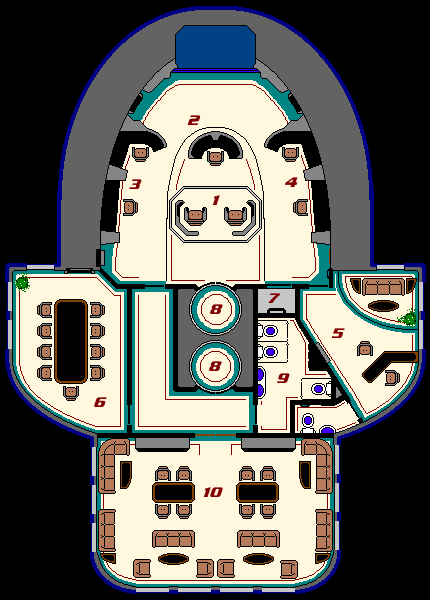 1. Command Platform: The CO's and XO's seats are on a raised platform overlooking the rest of the
Bridge. Captain Lora Kor's seat is to starboard, nearer the Tactical and Science stations.
1. Command Platform: The CO's and XO's seats are on a raised platform overlooking the rest of the
Bridge. Captain Lora Kor's seat is to starboard, nearer the Tactical and Science stations.
2. Flight Operations: The Conn and Ops functions are combined into a single integrated Flight Operations console that sits forward of the command platform, aft of the Holographic Projection Viewer.
3. Mission Operations: The forward station is the Mission Ops console, the aft station is Engineering and Environmental Systems. The far forward panel near the holographic tank is programmed by default for Damage Control, but can be reprogrammed for any purpose. Aft of these stations is the Bridge replicator.
4. External Operations: The forward station is the Tactical console, the aft station is the Science console. The far forward station near the holographic tank is programmed for LORASON system control, but can be reprogrammed for any purpose. Aft of these stations is Coronado's dedication plaque.
5. Captain's Ready Room: Captain Lora Kor prefers a rather Spartan environment, and as such, the Ready Room is simply furnished, with a desk, chairs, computer console, couch, and a replicator. The room contains a forward window and overhanging bay windows with a spectacular view.
A single print hangs on the side wall near the door, "Ghosts of Penora" which depicts Coro in a high-energy warp entry following the mission that concluded on SD 240011.06. A model of a Spectre class fighter sits on one of the couch's end tables. An ancient longsword hangs behind the Captain's desk. The Captain's head is nearby, and is interesting in that it contains a small weapons locker with a PPP phaser pistol.
6. Conference Lounge: Nine chairs around a relatively simple table. The room contains a forward window and overhanging bay windows giving a spectacular view of outside space. A large viewscreen used for briefings dominates the wall next to the forward window. The Captain sits closest to the door.
7. Emergency Access: A ladderway gives access to deck 2, and can be used as an emergency airlock providing access outside of the ship. A docking port above this access allows for docking of small shuttles, shuttlepods, travel pods, and workbees. Six EVA suits are also stored in a small locker above the Bridge.
8. Turbolift. External interlink ports to connect to a Starbase turbolift network are included.
9. Bridge Head.
10. Wardroom: Also sometimes called the Officer's Mess. Large overhanging bay windows make this one of the ship's least structurally sound points, but the view is unparalleled. The doors are carbon-carbon fill, overlaid with oak veneer and are reinforced to endure vacuum if needed. Two large replicators are forward, with chairs, tables, and such aft, along with aft-facing windows with a good view down the spine of the ship, as well as the nacelles and shuttlebay.
Coronado's Main Engineering
Main Engineering aboard U.S.S. Coronado relies on many of the advanced technologies that makes the ship's Bridge module so successful. There are two separate holographic display networks in Engineering, not even counting the holographic emitters available for the Emergency Engineering Holographic programs. There have also been a number of advances incorporated into the design to take advantage of Starfleet's experiences over the past century.
The center of Engineering is built around two locations: the ship's warp core and the Master Situation Monitor and Display. The former is maintained in a separate compartment, in order to allow the space to be sealed off in case of emergency. There are three separate safety interlocks for the warp core: a core-only containment field, able to contain a full loss of containment; a secondary containment field able to isolate the entire compartment; and a series of "drop-down" tetroburnium/tripolymer barriers that can be dropped should the containment fields fail.
The Master Situation Monitor is built into one wall, and is made up of both a wall display and a series of holographic emitters. These emitters can display any ship's area or function in a holographic space above the display table for monitoring or work. Monitors placed throughout the ship, both inside and out, make this display the single easiest way to determine the status of any part of Coronado. The display can show the entire ship, focus on a particular area or system, or display a cut-away diagram of any of the ship's various data or energy networks. A similar display is available in the Tactical Analysis Lab for use by the ship's Tactical department, for Security reasons.
Engineering is a two-level facility; the layout graphic below includes only the lower level, the more important. The upper level includes secondary control accesses, the galleries for the Conference Room, an engineering lounge, a head, more Jeffries tube accesses, and more direct access to the warp core. Aft of Main Engineering is a smaller facility reserved for slipstream engineering. The slipstream core is tied directly into the warp plasma conduit aft of Main Engineering.
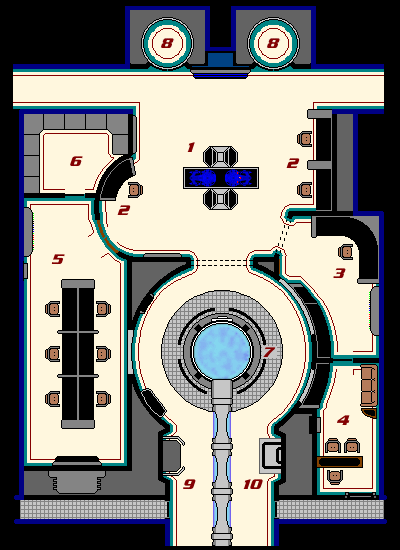 1. Master Systems Display: Being X-shaped rather than the traditional dumbbell allows nearly
twice as many people to work around the display. It also receives and displays the holographic information
provided by the Master Situation Monitor. The entire ship can be controlled from the MSD if needed,
including navigations, weapons, and internal defenses.
1. Master Systems Display: Being X-shaped rather than the traditional dumbbell allows nearly
twice as many people to work around the display. It also receives and displays the holographic information
provided by the Master Situation Monitor. The entire ship can be controlled from the MSD if needed,
including navigations, weapons, and internal defenses.
2. Engineering Control Consoles: These consoles can be reprogrammed for any function. By default, one is set up to monitor slipstream propulsion, one for warp and impulse propulsion, and one for ship's power and data flows.
3. Duty Engineer Station: The duty engineer works from this very large area. Several consoles are available, as well as a display wall and access to the ship's biometric control configuration. A pair of transparent aluminum windows allow the duty engineer to visually monitor the warp core.
4. Chief Engineer's Office: The Chief Engineer can either work from the duty engineer's station or this private office. A desktop computer and wall display is provided, and the office can be redecorated to suit the ship's Chief Engineer and his or her working habits. A replicator is also provided, as well as a transparent aluminum window that gives visual access to the warp core. The window can be darkened if desired. A work console is also provided to allow the Chief Engineer to work in private if that is desired.
5. Conference Room: Engineering has a dedicated Conference Room, which is actually a two-level facility. On Engineering's main level are a table with six chairs (computer consoles at each station), a holographic wall projector similar to the one used for the MSD, a control/status display, and a replicator. The Conference Room also extends into the Engineering upper level, where there is an observation gallery with seating for as many as 24 people. The design is intended to allow the Chief Engineer to hold staff meetings with his or her technical leads on the main level, with the full Engineering staff in attendance from the galleries, if need be.
6. Parts Room: Racks and replicators are available to provide virtually any tool, part, or equipment needed by the Engineering staff. Anything from a single isolinear rod to a full impulse reactor can be built from parts available, and anything not available can be replicated.
7. Warp core: Coronado's warp core extends for seven decks up and six decks down from this location. Transparent aluminum flooring allows engineers to monitor the core below Engineering, and similar features in the upper level allow visual monitoring of the core over deck 15. Each of the four rails has small control consoles available to control specific aspects of the core.
8. Turbolift. Two are provided for quick access to Engineering. Two more are available just outside Slipstream Engineering, aft of Main Engineering.
9. Lift. One or two people can ride this lift to the Engineering upper level.
10. Ladderway: Panels in the floor and ceiling allow ladderway access to other parts of the ship, particularly areas of concern to engineering. A safety bar is provided with each rung to prevent falls. Between the lift and ladderway is the warp plasma conduit. Just aft of both are Jeffries tube accesses to the split plasma conduits feeding both nacelles and other engineering support spaces.
Once you're done here, tap Back to return to the Coronado information index or the Return key at the bottom of your PADD, and you will be returned to the main index.





 © Copyright 2002,