 On Stardate 240104.23, Starfleet Task Group 5.4, while escorting the captured
Rihannsu starship S.R.R. Sienov Temarr, came under attack by a Rihannsu
"hunter" group which had been sent behind Federation lines months earlier.
The Federation-Klingon-Romulan War was in full swing, and the Rihannsu group
attempted to destroy the captured Ra'Kalen class destroyer. In the process of
evading the hunters, Task Group 5.4 entered the Hayashi system, hoping to hide
in the system's complex radiation anomalies. What they found instead was
a completed Traxati hypergate and a star in an unstable pre-nova state. Driven
deeper into the system by the hunter group, the ships of Task Group 5.4 watched
their warp drives fail one by one, victim of the radiation anomalies in the
system. It became clear that instead of bringing the Starfleet group to battle,
the Rihannsu hunter group was content to let the supernova do their work for
them. With no escape possible, Vice Admiral Brian Aldur, in command of the
group, made a fateful decision: he ordered the ships of Task Group 5.4 through
the hypergate.
On Stardate 240104.23, Starfleet Task Group 5.4, while escorting the captured
Rihannsu starship S.R.R. Sienov Temarr, came under attack by a Rihannsu
"hunter" group which had been sent behind Federation lines months earlier.
The Federation-Klingon-Romulan War was in full swing, and the Rihannsu group
attempted to destroy the captured Ra'Kalen class destroyer. In the process of
evading the hunters, Task Group 5.4 entered the Hayashi system, hoping to hide
in the system's complex radiation anomalies. What they found instead was
a completed Traxati hypergate and a star in an unstable pre-nova state. Driven
deeper into the system by the hunter group, the ships of Task Group 5.4 watched
their warp drives fail one by one, victim of the radiation anomalies in the
system. It became clear that instead of bringing the Starfleet group to battle,
the Rihannsu hunter group was content to let the supernova do their work for
them. With no escape possible, Vice Admiral Brian Aldur, in command of the
group, made a fateful decision: he ordered the ships of Task Group 5.4 through
the hypergate.
 Task Group 5.4 escaped through the hypergate with heavy damage to several of
their member ships. Behind them, the star erupted into a supernova,
obliterating the drives that controlled the hypergate in the Hayashi system
and sending the gate tumbling out of the remains of the system. The gate,
being neutronium, could not be consumed by the exploding star, but the delicate
balance that allowed it to operate was destroyed with the rest of the system.
U.S.S. Coronado, along with the other ships of Task Group 5.4, found
themselves on the far side of the hypergate... which led to the galaxy known
in the Milky Way as M64. Task Group 5.4 is more than nineteen million
light years from home. The entire group is listed on Starfleet records as
presumed destroyed.
Task Group 5.4 escaped through the hypergate with heavy damage to several of
their member ships. Behind them, the star erupted into a supernova,
obliterating the drives that controlled the hypergate in the Hayashi system
and sending the gate tumbling out of the remains of the system. The gate,
being neutronium, could not be consumed by the exploding star, but the delicate
balance that allowed it to operate was destroyed with the rest of the system.
U.S.S. Coronado, along with the other ships of Task Group 5.4, found
themselves on the far side of the hypergate... which led to the galaxy known
in the Milky Way as M64. Task Group 5.4 is more than nineteen million
light years from home. The entire group is listed on Starfleet records as
presumed destroyed.
Superheated gasses and white-hot plasma followed us from the supernova and
erupted through this hypergate, obliterating its control drives. Without the
ability to adjust the hypergate's spin rate, we have no way to respin the gate
to return us home. Nobody in the Milky Way galaxy knows the "address" of our
gate and we have no way to tell them. Task Group 5.4 is alone as no other
Federation members have been before with little hope of ever reaching home.
Task Group 5.4 comprises twelve Starfleet capital ships including an Eclipse
class battlecruiser and a Sovereign class explorer, four Federation
support ships, fifteen Camelynian ships, and the captured Rihannsu destroyer.
The group also includes 288 small attack fighters of various types, two
Starfleet tugs, four corvette-class ships, about two dozen total ships of
runabout size, and almost 200 shuttlecraft of various types. About 5,000
Starfleet members call the task group home, in addition to about 1,500
Starfleet Marines, 200 Federation civilians, and about 7,000 Camelynians.
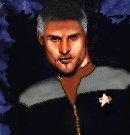 In overall command of Task Group 5.4 is Starfleet Vice Admiral Brian Aldur.
Brian Aldur is human, about 60 years old, born and raised on Titan in the
Sol system. He has been in Starfleet for four decades since joining as a
Starfleet Marine during the height of the first Cardassian War. He later
spent more than 15 years in starship command, gaining credit for his ability
to extract his ships from extremely hazardous situations. He was also known
as a Starfleet "trouble-shooter" for some time, an ability that he put to
good use in his task group command roles. Aldur is an extremely dedicated,
efficient officer. Known throughout Starfleet for his cunning in battle, the
Admiral has a reputation for ruthlessness against his enemies, but is also
extremely caring of the personnel under his command.
In overall command of Task Group 5.4 is Starfleet Vice Admiral Brian Aldur.
Brian Aldur is human, about 60 years old, born and raised on Titan in the
Sol system. He has been in Starfleet for four decades since joining as a
Starfleet Marine during the height of the first Cardassian War. He later
spent more than 15 years in starship command, gaining credit for his ability
to extract his ships from extremely hazardous situations. He was also known
as a Starfleet "trouble-shooter" for some time, an ability that he put to
good use in his task group command roles. Aldur is an extremely dedicated,
efficient officer. Known throughout Starfleet for his cunning in battle, the
Admiral has a reputation for ruthlessness against his enemies, but is also
extremely caring of the personnel under his command.
Vice Admiral Aldur's flagship is U.S.S. Stirling, NCC-84378, an
Eclipse class battlecruiser. More than 1000 meters long, the Eclipse class
ships are among the biggest ships ever fielded by Starfleet. Intended to be fleet
command ships, all are fitted with removable modules providing various capabilities.
 The module installed on Stirling is a long-range subspace communications
and ECM/ECCM module. With this module in place, Stirling is able to
send and receive subspace communications at ranges exceeding 90 light-years.
Normal subspace communications has a limit of about 22 light-years before the
signal degrades to silence.
The module installed on Stirling is a long-range subspace communications
and ECM/ECCM module. With this module in place, Stirling is able to
send and receive subspace communications at ranges exceeding 90 light-years.
Normal subspace communications has a limit of about 22 light-years before the
signal degrades to silence.
Stirling can act as a mobile long-distance communications relay between
distant ships or bases, or can jam subspace communications over an extremely
wide range. She can also receive LORASON sensor platform information from one
ship and relay it to a distant ship using her communications suite. In addition,
communications from Stirling propogate somewhat faster than standard
subspace communications, achieving speeds exceeding warp 9.9999 and data
transmission rates approaching 100 kiloquads per second.
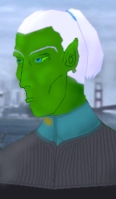 Commanding Vice Admiral Aldur's flagship is Fleet Captain Rel'ao Narque. Narque
is a Dekora, generally regarded as a race of borderline pacifists. However, this
is seriously oversimplifying the case. Dekora are, by and large, very spiritual
beings. Among the distinctive traits he exhibits as a Dekora, Narque has a high
psi-sensitivity and frequently borders on full empathic ability (most notably when
interacting with telepathic or empathically gifted species). This trait, combined
with his culture's strong love of spiritual neutrality and inner peace helps him
to understand the feelings and minds of others. He posesses a natural concern for
the universe, and joined Starfleet primarily because he seeks to nurture the
spiritual strength of the Federation and its companion Alpha Quadrant powers.
Narque's race of Dekora is easily medically identifiable by their copper-based
blood, green-tinted skin, upward-pointed ears and highly developed neural pathways.
Physiologically, Dekora are in many ways similar to Vulcans, Rigellians, Romulans,
and Orions. They posess these races' resiliency against harsh climate conditions;
their planet itself dominated by a cold desert climate and nitrogen-rich atmosphere.
Commanding Vice Admiral Aldur's flagship is Fleet Captain Rel'ao Narque. Narque
is a Dekora, generally regarded as a race of borderline pacifists. However, this
is seriously oversimplifying the case. Dekora are, by and large, very spiritual
beings. Among the distinctive traits he exhibits as a Dekora, Narque has a high
psi-sensitivity and frequently borders on full empathic ability (most notably when
interacting with telepathic or empathically gifted species). This trait, combined
with his culture's strong love of spiritual neutrality and inner peace helps him
to understand the feelings and minds of others. He posesses a natural concern for
the universe, and joined Starfleet primarily because he seeks to nurture the
spiritual strength of the Federation and its companion Alpha Quadrant powers.
Narque's race of Dekora is easily medically identifiable by their copper-based
blood, green-tinted skin, upward-pointed ears and highly developed neural pathways.
Physiologically, Dekora are in many ways similar to Vulcans, Rigellians, Romulans,
and Orions. They posess these races' resiliency against harsh climate conditions;
their planet itself dominated by a cold desert climate and nitrogen-rich atmosphere.
Task Group 5.4's other "big ship" is U.S.S. Odyssey, NCC-71832-B, a
Sovereign class explorer. Odyssey was sent with the task group because she
received severe damage on the Rihannsu front lines... damage that was only made
worse during the initial battle that brought the group to M64.
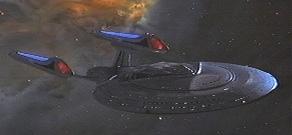 U.S.S. Odyssey is a fairly typical Sovereign, with a large crew compliment,
lush quarters and facilities, impressive diplomatic capabilities, and extremely
strong defensive weapons. Normally, this would be the ship that is sent out to
make contact with the races that might be nearby. However, the task group's
initial job is to bring Odyssey back to spec after her damaging ordeals.
Obviously, spare parts are somewhat difficult to come by, and as a result, the
big ship generally stays close to M.R.F. Pearl.
U.S.S. Odyssey is a fairly typical Sovereign, with a large crew compliment,
lush quarters and facilities, impressive diplomatic capabilities, and extremely
strong defensive weapons. Normally, this would be the ship that is sent out to
make contact with the races that might be nearby. However, the task group's
initial job is to bring Odyssey back to spec after her damaging ordeals.
Obviously, spare parts are somewhat difficult to come by, and as a result, the
big ship generally stays close to M.R.F. Pearl.
 The commanding officer of Odyssey is Captain Christina Margrove. Margrove
is human and in her mid-30s, and is of almost pure Scotch-Irish descent, born
in Dublin, Ireland on Earth. Margrove is a being of very strong emotions, both
positive and negative. She has a temper that his second only to her compassion,
anger that is second only to joy. She quite often excuses herself for several
minutes during emotional situations, so as to not make command decisions that
are biased by emotion. However, in critical situations, she is more than capable
of putting her feelings aside and operating with an icy calm that a Vulcan might
admire. She is a very bad enemy, but a very good friend.
The commanding officer of Odyssey is Captain Christina Margrove. Margrove
is human and in her mid-30s, and is of almost pure Scotch-Irish descent, born
in Dublin, Ireland on Earth. Margrove is a being of very strong emotions, both
positive and negative. She has a temper that his second only to her compassion,
anger that is second only to joy. She quite often excuses herself for several
minutes during emotional situations, so as to not make command decisions that
are biased by emotion. However, in critical situations, she is more than capable
of putting her feelings aside and operating with an icy calm that a Vulcan might
admire. She is a very bad enemy, but a very good friend.
It is always a mistake to underestimate Margrove -- she delights in being
underestimated. Her physical stature (Margrove is less than 1.5 meters tall)
only exacerbates the tendency for people to underestimate her capapbilities.
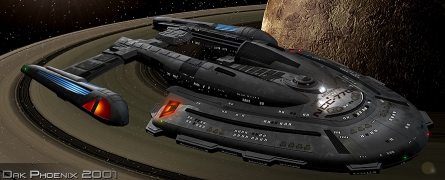 The newest addition to the task group is U.S.S. Vanguard, NCC-87947, which
was pulled through the hypergate in Hayashi months after the rest of the group
fled the supernova. An experimental testbed cruiser, Vanguard is endlessly
modfiable and easily upgradable with six modular support slots and a modular
mission pod clamp. At 560m in length, Vanguard is classified as a heavy cruiser.
The newest addition to the task group is U.S.S. Vanguard, NCC-87947, which
was pulled through the hypergate in Hayashi months after the rest of the group
fled the supernova. An experimental testbed cruiser, Vanguard is endlessly
modfiable and easily upgradable with six modular support slots and a modular
mission pod clamp. At 560m in length, Vanguard is classified as a heavy cruiser.
Built to develop and prove new technologies, the ship is the second vessel to
arrive in M64 with a transwarp drive, is also the only vessel other than Coronado
to carry a LORASON sensor system, and mounts a one-of-a-kind subspace concealment
and scanning device. However, Vanguard isn't a science ship; she is more than
capable of defending herself in any hostile situation with a heavy phaser
armament and a full squadron of Jaguar fighter-bombers.
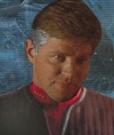 Vanguard's commanding officer, Rear Admiral Todd "Maniac" Marshall, has been
jokingly referred to as Brian Aldur's 'Knight in Shining Armor' as a result of his
dedication and often routine rescue attempts of his former commanding officer.
Despite their nearly opposite personalities, he and Aldur are lifelong friends. A
former test pilot and R&D officer for almost twenty-five years, Marshall has a
well-deserved reputation for driving his superior officers up the wall with the
radical and unconventional thinking and tactics that earned him his moniker. Easily
the most amicable and humourous flag officer in the task group, Marshall acts more
like a cowboy than an Admiral, a trait that could both get the group into trouble,
or ease highly tense situations.
Vanguard's commanding officer, Rear Admiral Todd "Maniac" Marshall, has been
jokingly referred to as Brian Aldur's 'Knight in Shining Armor' as a result of his
dedication and often routine rescue attempts of his former commanding officer.
Despite their nearly opposite personalities, he and Aldur are lifelong friends. A
former test pilot and R&D officer for almost twenty-five years, Marshall has a
well-deserved reputation for driving his superior officers up the wall with the
radical and unconventional thinking and tactics that earned him his moniker. Easily
the most amicable and humourous flag officer in the task group, Marshall acts more
like a cowboy than an Admiral, a trait that could both get the group into trouble,
or ease highly tense situations.
While technically not as large as Stirling or Odyssey, one of the
task group's premiere battleships is U.S.S. Gryphon, NCC-62899, an
Akira class through-deck carrier. Gryphon fields 36 of the task group's
attack fighters, and is often the temporary home to many of the others, including
the short range Camelynian fighter craft.
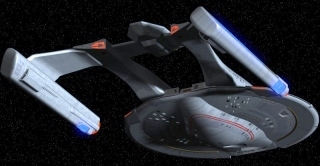 Akira through-deck carriers (sometimes referred to as "Akira Cs") are the modern
equivalent of 20th century aircraft carriers. Gryphon relies on her
fighters for long-range striking power, and is armed with only minimal phasers.
However, she carries a terrifying number of torpedo tubes for a Starfleet vessel;
her upper module is a dedicated torpedo launcher, and Akiras generally include
port and starboard torpedo launchers as a matter of course, very unusual in a
Starfleet design. Even the most dedicated destroyer captain will rethink his
options when faced with Gryphon driving through a firefight, throwing as
many as 20 torpedoes simultaneously.
Akira through-deck carriers (sometimes referred to as "Akira Cs") are the modern
equivalent of 20th century aircraft carriers. Gryphon relies on her
fighters for long-range striking power, and is armed with only minimal phasers.
However, she carries a terrifying number of torpedo tubes for a Starfleet vessel;
her upper module is a dedicated torpedo launcher, and Akiras generally include
port and starboard torpedo launchers as a matter of course, very unusual in a
Starfleet design. Even the most dedicated destroyer captain will rethink his
options when faced with Gryphon driving through a firefight, throwing as
many as 20 torpedoes simultaneously.
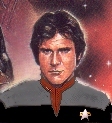 The commanding officer of Gryphon is a very unusual being -- Captain John
Henes X is an android, only the second android to be offered command of a starship.
Based roughly on the Noonian Soong design, Henes has both advantages and disadvantages
over other androids of the same type. Henes is mistakable for human with human
coloring and mannerisms. However, his left arm is easily and quickly replaceable
with a variety of components, including heavy weapons... Henes has been in continuous
command of Gryphon for more than 25 years, through several major refits. He
shows no particular desire for higher command, telling anyone who will ask and not a
few that don't that he feels he has reached his first best destiny.
The commanding officer of Gryphon is a very unusual being -- Captain John
Henes X is an android, only the second android to be offered command of a starship.
Based roughly on the Noonian Soong design, Henes has both advantages and disadvantages
over other androids of the same type. Henes is mistakable for human with human
coloring and mannerisms. However, his left arm is easily and quickly replaceable
with a variety of components, including heavy weapons... Henes has been in continuous
command of Gryphon for more than 25 years, through several major refits. He
shows no particular desire for higher command, telling anyone who will ask and not a
few that don't that he feels he has reached his first best destiny.
The other major battleship in Task Group 5.4 is U.S.S. Fearless, NCC-59655,
a Prometheus II class light cruiser. Like all Prometheus class ships, Fearless
is capable of dividing into three frigate-size warships, each capable of operating
semi-autonomously within a limited range from each other, a protocol known
as "Multi-Vector Assault Mode."
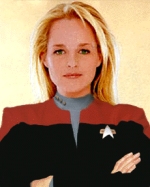 Commanding Fearless is Captain Jennifer Mitchell, one of the youngest Captains
in Starfleet. Though superficially human, Mitchell is a native of Palkao Est. Like all
Esties, Mitchell is extremely driven and determined. She is also very sure of herself,
a tendency that is deserved: Captain Mitchell routinely places near the top of Starfleet
in tactical simulations and wargames, and is probably second only to Aldur in the
task group as a battle strategist. Natives of Palkao Est are believed to be humans
removed from Earth by the Preservers in 1st and 2nd century Europe. Over the
centuries, Esties have developed in different ways from Earth humans -- they have
more sensitive hearing and are more flexible and dextrous. However, Esties generally
have no psi ability at all, and Mitchell is no exception in this regard. An Estie and
a human cannot successfully breed without significant medical intervention; there
have been significant genetic and chromosomal changes over the centuries since the
Preservers separated out the Palkao Est natives.
Commanding Fearless is Captain Jennifer Mitchell, one of the youngest Captains
in Starfleet. Though superficially human, Mitchell is a native of Palkao Est. Like all
Esties, Mitchell is extremely driven and determined. She is also very sure of herself,
a tendency that is deserved: Captain Mitchell routinely places near the top of Starfleet
in tactical simulations and wargames, and is probably second only to Aldur in the
task group as a battle strategist. Natives of Palkao Est are believed to be humans
removed from Earth by the Preservers in 1st and 2nd century Europe. Over the
centuries, Esties have developed in different ways from Earth humans -- they have
more sensitive hearing and are more flexible and dextrous. However, Esties generally
have no psi ability at all, and Mitchell is no exception in this regard. An Estie and
a human cannot successfully breed without significant medical intervention; there
have been significant genetic and chromosomal changes over the centuries since the
Preservers separated out the Palkao Est natives.
 Fearless herself is perfectly suited to Mitchell's command style. Though the
amenities are minimal, the Prometheus II class is Starfleet's foremost combat ship
and the crew takes great pride from that. All of them are supremely devoted to
Starfleet and their ship. Before becoming trapped with the rest of Task Group 5.4,
Fearless had earned three battle stars and single-handedly destroyed a Klingon
Voodieh class dreadnought using the superior speed and maneuverability of her "vectors,"
the ships that Fearless separates into when she engages MVAM.
Fearless herself is perfectly suited to Mitchell's command style. Though the
amenities are minimal, the Prometheus II class is Starfleet's foremost combat ship
and the crew takes great pride from that. All of them are supremely devoted to
Starfleet and their ship. Before becoming trapped with the rest of Task Group 5.4,
Fearless had earned three battle stars and single-handedly destroyed a Klingon
Voodieh class dreadnought using the superior speed and maneuverability of her "vectors,"
the ships that Fearless separates into when she engages MVAM.
Task Group 5.4 includes two Katana class frigates, U.S.S. Coronado, NCC-97901
and U.S.S. Renegade, NCC-97902. Both ships are Marine frigates equipped
with slipstream drives. The overall Marine contingent, including the Marines aboard
Douglas MacArthur, about 1200 strong, is under the command of Colonel Jeremy
Ironside from Coronado. Both ships are also light fighter carriers, with 16
Spectre class light fighters between them. Coronado's uniqueness to the group
is in two forms: first, she is one of two LORASON-equipped ships in the group, giving the
task group a view out to 60 light-years from the frigate. Second, Coro was
refitted during the war to serve as a supply ship for four Wraith class Corvettes,
Squadron SO-2, "The Raptors."
 U.S.S. Renegade is unique among Katana class frigates in that she carries a full
science and research suite in two of her detachable saucer sections, making her nearly the
equal of an Intrepid class explorer. 'gade's crew is also weighted toward science-
and diplomacy-trained personnel. Renegade also has a much lower resupply
requirement than her sister ship. Unfortunately, the modifications that made Coro
capable of resupplying the Wraiths removed much of her consumables and emergency storage,
meaning that when a long-distance mission is required, it is Renegade that gets
it. Vice Admiral Aldur is considering many options to address this, including trading
some of the saucer segments between his two Katanas.
U.S.S. Renegade is unique among Katana class frigates in that she carries a full
science and research suite in two of her detachable saucer sections, making her nearly the
equal of an Intrepid class explorer. 'gade's crew is also weighted toward science-
and diplomacy-trained personnel. Renegade also has a much lower resupply
requirement than her sister ship. Unfortunately, the modifications that made Coro
capable of resupplying the Wraiths removed much of her consumables and emergency storage,
meaning that when a long-distance mission is required, it is Renegade that gets
it. Vice Admiral Aldur is considering many options to address this, including trading
some of the saucer segments between his two Katanas.
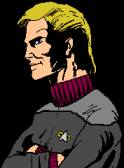 The commanding officer of Renegade is Captain Stuart Morgan, an Earth human in
his late 30s. Morgan is somewhat of a free spirit, somewhat unusual for a Starfleet
Captain. Like most Marine frigate COs, Morgan is a former Marine and former pilot.
Unlike most Marine frigate COs, Morgan has an extremely dry, almost sarcastic
wit and considers himself an ambassador to Starfleet and the Federation. He is also
regarded as one of the foremost experts on Rihannsu culture in Starfleet, one of the
reasons he was brought in to consult on the capture of the Rihannsu destroyer
Sienov Temarr. Morgan hails from California, and like many Starfleet Captains,
plays as hard as he works. Though Starfleet's charter is to "boldly go where no one
has gone before," Morgan considers himself more of a soldier than an explorer.
Renegade's configuration is slowly changing his view of himself -- he's
finding he has a talent for exploration.
The commanding officer of Renegade is Captain Stuart Morgan, an Earth human in
his late 30s. Morgan is somewhat of a free spirit, somewhat unusual for a Starfleet
Captain. Like most Marine frigate COs, Morgan is a former Marine and former pilot.
Unlike most Marine frigate COs, Morgan has an extremely dry, almost sarcastic
wit and considers himself an ambassador to Starfleet and the Federation. He is also
regarded as one of the foremost experts on Rihannsu culture in Starfleet, one of the
reasons he was brought in to consult on the capture of the Rihannsu destroyer
Sienov Temarr. Morgan hails from California, and like many Starfleet Captains,
plays as hard as he works. Though Starfleet's charter is to "boldly go where no one
has gone before," Morgan considers himself more of a soldier than an explorer.
Renegade's configuration is slowly changing his view of himself -- he's
finding he has a talent for exploration.
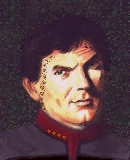 Of course, the commanding officer of Coronado is Fleet Captain Tebrun Lora Kor.
Kor is a Trill whose symbiont is nearly 400 years old; the Tebrun host is Kor's seventh
and is in his late 30s. The two are a stable pairing. Kor is a fatherly, serene
personality that like many Trill, takes the long view of problems and situations. It
is incredibly rare to see him frightened or angry, or possessed by any other negative
emotion; he practically projects calm. Kor is an ex-engineer and ex-scientist,
somewhat unusual for a Marine frigate CO but his Trill background and experience allows
him to become extremely practical at need. He is a somewhat unconventional tactician,
using his knowledge of history to remake past strategies fit present-day events and
circumstances. Kor can see the good in almost anyone, and often struggles to make
others of low self-esteem see themselves as he sees them.
Of course, the commanding officer of Coronado is Fleet Captain Tebrun Lora Kor.
Kor is a Trill whose symbiont is nearly 400 years old; the Tebrun host is Kor's seventh
and is in his late 30s. The two are a stable pairing. Kor is a fatherly, serene
personality that like many Trill, takes the long view of problems and situations. It
is incredibly rare to see him frightened or angry, or possessed by any other negative
emotion; he practically projects calm. Kor is an ex-engineer and ex-scientist,
somewhat unusual for a Marine frigate CO but his Trill background and experience allows
him to become extremely practical at need. He is a somewhat unconventional tactician,
using his knowledge of history to remake past strategies fit present-day events and
circumstances. Kor can see the good in almost anyone, and often struggles to make
others of low self-esteem see themselves as he sees them.
 Coronado is the primary repair and resupply ship for the task group's four Wraith
class corvettes, Wraith Squadron SO-2, "The Raptors." The Wraiths, of course, are the
reason why Task Group 5.4 is in the fix it is in. Without the Wraiths, the group would
not have been able to successfully capture Sienov Temarr. For the capture
operation, the Wraiths were configured as Wraith "Liberators," fielding the White Lightning
computer weapon. However, Wraiths are modular and can be reconfigured to many different
layouts. Normally, The Raptors are fitted in the "Avenger" configuration, which uses
more conventional weapons than the Liberator variant.
Coronado is the primary repair and resupply ship for the task group's four Wraith
class corvettes, Wraith Squadron SO-2, "The Raptors." The Wraiths, of course, are the
reason why Task Group 5.4 is in the fix it is in. Without the Wraiths, the group would
not have been able to successfully capture Sienov Temarr. For the capture
operation, the Wraiths were configured as Wraith "Liberators," fielding the White Lightning
computer weapon. However, Wraiths are modular and can be reconfigured to many different
layouts. Normally, The Raptors are fitted in the "Avenger" configuration, which uses
more conventional weapons than the Liberator variant.
Task Group 5.4's other five Starfleet capital ships are of small escort- and
destroyer-size classes. Two are technically non-combatants, U.S.S. Swiftsure,
NCC-65031 and U.S.S. Schweitzer, NCC-55019.
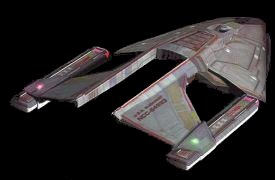 Swiftsure is a Norway class starship. Though technically listed as a destroyer,
Norways are actually ambassadorial transports and blockade runners. Other than a pair
of light torpedo launchers, their only real weapon is a forward-mounted heavy phaser
cannon. The cannon is aimed by turning the entire ship in the direction of fire and
for this reason, Swiftsure is quite maneuverable. Under normal circumstances,
Norway class ships rely on their single heavy weapon and their maneuverability to win
through blockaded systems or heavy interference. Norways are also noted for their
opulent crew and guest comforts. Swiftsure was brought with the task group to
serve as a negotiating location for the Camelynians, who were involved with the group's
final mission in the Milky Way galaxy.
Swiftsure is a Norway class starship. Though technically listed as a destroyer,
Norways are actually ambassadorial transports and blockade runners. Other than a pair
of light torpedo launchers, their only real weapon is a forward-mounted heavy phaser
cannon. The cannon is aimed by turning the entire ship in the direction of fire and
for this reason, Swiftsure is quite maneuverable. Under normal circumstances,
Norway class ships rely on their single heavy weapon and their maneuverability to win
through blockaded systems or heavy interference. Norways are also noted for their
opulent crew and guest comforts. Swiftsure was brought with the task group to
serve as a negotiating location for the Camelynians, who were involved with the group's
final mission in the Milky Way galaxy.
 Skippers of Norway class ships often have a very deserved "daredevil" reputation, and
the commanding officer of Swiftsure, Commander Morgan "Chappy" Chapel, is no
exception. An Afrikaaner from Proxima Beta, Chappy has been accused of being a master
manipulator. According to one story, one of her former instructors swore up and down
that someone so beautiful would be completely unable to command respect... right up
until Chappy allegedly dropped him to the deck with a well-placed knee. Such anecdotes
commonly swirl around Chapel, who jokes that she wishes only half of them were true.
However, her crew is every bit as enthusiastic as she is and her command style is a
perfect match to both them and her ship. Chappy's crew would do anything for her, and
she repays their loyalty by bringing them out of ugly situation after ugly situation...
Chappy describes herself as a "balls out, take no prisoner type." She seems to have no
illusions about her own strengths and limitations.
Skippers of Norway class ships often have a very deserved "daredevil" reputation, and
the commanding officer of Swiftsure, Commander Morgan "Chappy" Chapel, is no
exception. An Afrikaaner from Proxima Beta, Chappy has been accused of being a master
manipulator. According to one story, one of her former instructors swore up and down
that someone so beautiful would be completely unable to command respect... right up
until Chappy allegedly dropped him to the deck with a well-placed knee. Such anecdotes
commonly swirl around Chapel, who jokes that she wishes only half of them were true.
However, her crew is every bit as enthusiastic as she is and her command style is a
perfect match to both them and her ship. Chappy's crew would do anything for her, and
she repays their loyalty by bringing them out of ugly situation after ugly situation...
Chappy describes herself as a "balls out, take no prisoner type." She seems to have no
illusions about her own strengths and limitations.
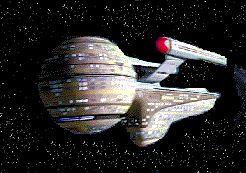 U.S.S. Schweitzer is Task Group 5.4's single medical frigate. The ship was
along for the ride mostly because when the final mission in the Milky Way began, most
of the crew of U.S.S. Odyssey was receiving treatment in Schweitzer's
hospital wings. Armed with only minimal weapons and shields and carrying
only light sensors, Schweitzer's talents are turned almost entirely inward,
toward her hospital wings and recreational and rehabilitation facilities. Crew
comforts aboard Hope class medical frigates are second only to Norway class facilities,
and of course Schweitzer's crew leans heavily toward Starfleet's medical and
life science specialties. However, there are a number of physical scientists aboard
as well who were escaping the front lines aboard the frigate.
U.S.S. Schweitzer is Task Group 5.4's single medical frigate. The ship was
along for the ride mostly because when the final mission in the Milky Way began, most
of the crew of U.S.S. Odyssey was receiving treatment in Schweitzer's
hospital wings. Armed with only minimal weapons and shields and carrying
only light sensors, Schweitzer's talents are turned almost entirely inward,
toward her hospital wings and recreational and rehabilitation facilities. Crew
comforts aboard Hope class medical frigates are second only to Norway class facilities,
and of course Schweitzer's crew leans heavily toward Starfleet's medical and
life science specialties. However, there are a number of physical scientists aboard
as well who were escaping the front lines aboard the frigate.
 Like virtually all Hope class vessels, the commanding officer of U.S.S. Schweitzer
is an M.D., in this case Commander Jania Shiid. Shiid is a Trill, but a relatively
young one. The Shiid symbiont is only about a century old and the Jania host isn't
quite 30 yet. As a result, Commander Shiid generally feels a little bit out of her
league, especially in Task Group 5.4's current circumstances. She is more than content
to "mind the store" and let the other ships and COs take the lead on how to get the
task group home. It is not unusual for the crews of the other Starfleet ships to
congregate aboard Schweitzer and take advantage of the medical frigate's
recreational capabilities, and Shiid is happy to play host and den mother to the
Federation-member sentients trapped in M64. Though not a particularly capable
tactical CO, Shiid is a more than competent doctor and administrator. She is often
the butt of practical jokes because she is extremely organized -- almost anal -- even
by Starfleet standards...
Like virtually all Hope class vessels, the commanding officer of U.S.S. Schweitzer
is an M.D., in this case Commander Jania Shiid. Shiid is a Trill, but a relatively
young one. The Shiid symbiont is only about a century old and the Jania host isn't
quite 30 yet. As a result, Commander Shiid generally feels a little bit out of her
league, especially in Task Group 5.4's current circumstances. She is more than content
to "mind the store" and let the other ships and COs take the lead on how to get the
task group home. It is not unusual for the crews of the other Starfleet ships to
congregate aboard Schweitzer and take advantage of the medical frigate's
recreational capabilities, and Shiid is happy to play host and den mother to the
Federation-member sentients trapped in M64. Though not a particularly capable
tactical CO, Shiid is a more than competent doctor and administrator. She is often
the butt of practical jokes because she is extremely organized -- almost anal -- even
by Starfleet standards...
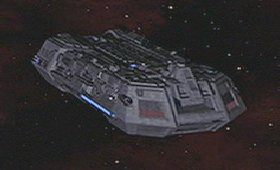 An almost accidental member of the task group is U.S.S. Douglas MacArthur, NCC-77043,
one of Starfleet's rare Tobruk class Marine transports. Capable of transporting 500
Starfleet Marines in relative comfort, MacArthur also incorporates 14 long-range
assault transporters and extensive internal holodecks, intended for training of the
ship's troops. Virtually any environment or assault scenario can be constructed in the
ship's holodeck as the transport moves to its target, allowing the Marines to train for
the upcoming mission while en route. Because Coronado lost many Marines during
her capture of Blackrazor, MacArthur had been called in to replace Coro's
troops and became trapped with the rest of the group.
An almost accidental member of the task group is U.S.S. Douglas MacArthur, NCC-77043,
one of Starfleet's rare Tobruk class Marine transports. Capable of transporting 500
Starfleet Marines in relative comfort, MacArthur also incorporates 14 long-range
assault transporters and extensive internal holodecks, intended for training of the
ship's troops. Virtually any environment or assault scenario can be constructed in the
ship's holodeck as the transport moves to its target, allowing the Marines to train for
the upcoming mission while en route. Because Coronado lost many Marines during
her capture of Blackrazor, MacArthur had been called in to replace Coro's
troops and became trapped with the rest of the group.
 In command of the transport is Lt. Colonel William Jonté. Born on
Starbase 22, Jonté is a very experienced officer and is somewhat cynical. His training
has made him very hard-edged, but his position means he frequently deals with Starfleet
bureaucracy. He has little or no patience for what he terms "REMFs" -- the acronym is
an extremely impolite nickname for rear-echelon brass -- and in his dark moods sees the
Federation as stumbling from one disaster to another. He also has a very dry, somewhat
sarcastic sense of humor, heightened all the more by the group's current situation.
However, there is no denying that Jonté is a talented command officer and small unit
tactician. He is a particularly good assault planner and seems to have the rare ability
to put himself into the shoes of and think like his enemy, whomever that enemy might
happen to be. Jonté definitely has a rare insight into human nature...
In command of the transport is Lt. Colonel William Jonté. Born on
Starbase 22, Jonté is a very experienced officer and is somewhat cynical. His training
has made him very hard-edged, but his position means he frequently deals with Starfleet
bureaucracy. He has little or no patience for what he terms "REMFs" -- the acronym is
an extremely impolite nickname for rear-echelon brass -- and in his dark moods sees the
Federation as stumbling from one disaster to another. He also has a very dry, somewhat
sarcastic sense of humor, heightened all the more by the group's current situation.
However, there is no denying that Jonté is a talented command officer and small unit
tactician. He is a particularly good assault planner and seems to have the rare ability
to put himself into the shoes of and think like his enemy, whomever that enemy might
happen to be. Jonté definitely has a rare insight into human nature...
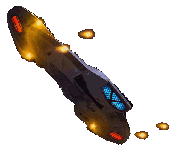 Task Group 5.4's single escort is U.S.S. Resolute, NCC-74211, a Defiant
II class vessel. Every Federation schoolchild knows of the history of the
Defiant class in her role as an anti-Borg weapons system. Like all Defiant IIs,
Resolute is a medium-range tactical vessel supporting overpowered engines,
weapons, and shields but minimal science, research, or long-term field capability.
The ship can only stray 90 days flight-time from resupply, which means in M64,
Resolute spends much of her time near the destroyed hypergate and the Camelynian
worldship. However, when danger threatens the group, Resolute's slipstream
capability can carry her into the firefight in minutes. Resolute also mounts
sophisticated sensors and the group's second-best cloaking device and therefore often
acts as one of Task Group 5.4's scouts.
Task Group 5.4's single escort is U.S.S. Resolute, NCC-74211, a Defiant
II class vessel. Every Federation schoolchild knows of the history of the
Defiant class in her role as an anti-Borg weapons system. Like all Defiant IIs,
Resolute is a medium-range tactical vessel supporting overpowered engines,
weapons, and shields but minimal science, research, or long-term field capability.
The ship can only stray 90 days flight-time from resupply, which means in M64,
Resolute spends much of her time near the destroyed hypergate and the Camelynian
worldship. However, when danger threatens the group, Resolute's slipstream
capability can carry her into the firefight in minutes. Resolute also mounts
sophisticated sensors and the group's second-best cloaking device and therefore often
acts as one of Task Group 5.4's scouts.
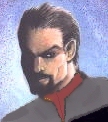 The commanding officer of Resolute is Commander John Zort, a Federation colonist
from Codis III. Codis, of course, was captured by the Romulans during the war, her
attendant Starbase Arcadia utterly destroyed. For this reason, Zort is not exactly
what you would call a fan of Romulans and is determined to "get back to home and to the
war and win a little payback." For this reason, Commander Zort is one of the leading
proponents in the group for long-range exploration. He is certain that where there is
one Traxati hypergate, there must be others that can be used to get the task group
home. Like many Defiant skippers and like many Federation colonists, Zort is a hard,
stubborn man, and difficult to deflect from his target, whatever that target may be.
The commanding officer of Resolute is Commander John Zort, a Federation colonist
from Codis III. Codis, of course, was captured by the Romulans during the war, her
attendant Starbase Arcadia utterly destroyed. For this reason, Zort is not exactly
what you would call a fan of Romulans and is determined to "get back to home and to the
war and win a little payback." For this reason, Commander Zort is one of the leading
proponents in the group for long-range exploration. He is certain that where there is
one Traxati hypergate, there must be others that can be used to get the task group
home. Like many Defiant skippers and like many Federation colonists, Zort is a hard,
stubborn man, and difficult to deflect from his target, whatever that target may be.
Task Group 5.4 also includes two escort destroyers, both Artemis class, U.S.S.
Athena, NCC-92004 and U.S.S. Thonus, NCC-92085. Athena
is under the command of Lt. Commander Ian Smythe, a Betazoid. Smythe has particularly
strong telepathic and empathic talents and spends much of his off-hours in meditation,
reestablishing his shields against the thoughts of others. Commanding Thonus is
Lt. Commander Tokia Shras, of Andor. Shras is a fine tactician and battle commander
like many Andorians... however, he is also quite able to see the practical situation
the task group is in and is an advocate of peaceful exploration of the region.
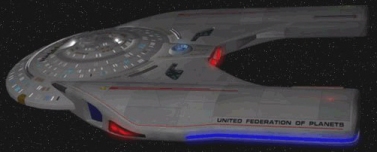 The Artemis class is the replacement for the Excelsior class, and is a fine successor.
Designed at Antares Fleet Yards near Andor, the Artemis class is maneuverable and
survivable, and features crew amenities that are usually reserved for much larger ships.
In particular, its weapons layout, twin deflector dishes, and heavy armoring on the
warp nacelles -- an Andorian design trademark -- make the Artemis a fine tactical ship.
However, Artemis destroyers also feature excellent sensor suites linked to their roles as
escort and patrol destroyers.
The Artemis class is the replacement for the Excelsior class, and is a fine successor.
Designed at Antares Fleet Yards near Andor, the Artemis class is maneuverable and
survivable, and features crew amenities that are usually reserved for much larger ships.
In particular, its weapons layout, twin deflector dishes, and heavy armoring on the
warp nacelles -- an Andorian design trademark -- make the Artemis a fine tactical ship.
However, Artemis destroyers also feature excellent sensor suites linked to their roles as
escort and patrol destroyers.
No discussion of Task Group 5.4 would be complete without the reason for its entrapment.
S.R.R. Sienov Temarr, SRR-1083 (named after "a sword fashioned from the night
sky" in a Rihanna folktale) is a Ra'Kalen class destroyer formerly crewed by the Rihannsu
Rei'Krannsu ("Rangers"). The reason the task group was gathered near Romulan space was
to effect the capture of this ship, which was done successfully on SD 240103.26.
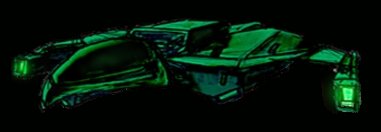 Blackrazor, as she is known internally within the task group, is about the size
of a Starfleet escort destroyer, about six decks high and 150 meters long. She is much
more heavily armed than a Starfleet destroyer, however, mounting twin subspace "warp guns"
and a variety of other weaponry. Much like a Starfleet Wraith, she mounts twin
miniature warp cores for speed and reliability and a very unusual but solid shield grid.
Blackrazor, as she is known internally within the task group, is about the size
of a Starfleet escort destroyer, about six decks high and 150 meters long. She is much
more heavily armed than a Starfleet destroyer, however, mounting twin subspace "warp guns"
and a variety of other weaponry. Much like a Starfleet Wraith, she mounts twin
miniature warp cores for speed and reliability and a very unusual but solid shield grid.
Blackrazor also features the most advanced cloak in the Rihannsu arsenal and until
her capture mounted shroud and phase cloak gear that was unfortunately destroyed during the
ship's capture. She was until recently the only transwarp-capable ship in the group -- one
of the major reasons for her capture was to give Starfleet a reproduceable transwarp core
arrangement. While data on Sienov Temarr's gear was transmitted to Starfleet R&D
after the ship's capture, it is unknown whether Starfleet will be able to make any use of
the data without the captured ship.
Task Group 5.4 also includes a number of Camelynian ships, starting with a "worldship" under
the command of Duke Henry Gaveston-Tudor of Cambrian Veils, and her escort Camelynian
destroyers. Camelyn is a long-time Federation associate member near Rihannsu space, and the
subject of the group's final official mission in the Milky Way galaxy before being trapped
in M64. Before joining the Federation, Camelyn was under almost constant attack by the
Romulan Star Empire. There is a long history between the Camelynians and the Rihannsu, most
of it unfriendly on both sides. While the two sides declared a brief truce during the
Dominion War to attack the common enemy of that war, hostilities resumed on both
sides not long after that conflict.
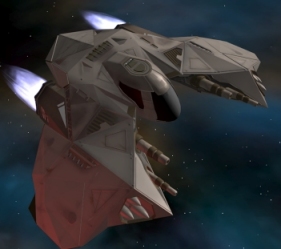 Camelynians are humanoids of technical development equivalent to about the late
23rd or early 24th centuries. However, the directions their technology have
taken are very different from Federation technology. Camelynians are a warp-
driven civilization whose engineering tends toward the "push-hard-until-it-moves"
variety. Their ships are generally larger than necessary and over-powered and
over-gunned for their size. As a result, their ships are sometimes
harsh on their operators, fragile, difficult to maintain, or all three.
Camelynians compensate for much of this through the use of extensive genetic
reengineering of their species -- the major reason for their former status as an
associate Federation member rather than a full one is their refusal to give up
this genetic engineering. The typical Camelynian is twice as fast, agile, strong,
and intelligent as the average human.
Camelynians are humanoids of technical development equivalent to about the late
23rd or early 24th centuries. However, the directions their technology have
taken are very different from Federation technology. Camelynians are a warp-
driven civilization whose engineering tends toward the "push-hard-until-it-moves"
variety. Their ships are generally larger than necessary and over-powered and
over-gunned for their size. As a result, their ships are sometimes
harsh on their operators, fragile, difficult to maintain, or all three.
Camelynians compensate for much of this through the use of extensive genetic
reengineering of their species -- the major reason for their former status as an
associate Federation member rather than a full one is their refusal to give up
this genetic engineering. The typical Camelynian is twice as fast, agile, strong,
and intelligent as the average human.
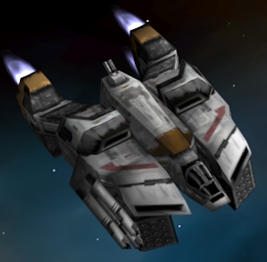 Camelyn is also interesting for being one of the galaxy's only technological
civilizations which is still run as a feudal monarchy. Serfdom is still very
much in effect despite the advanced technology, and the overall culture of
Camelyn mirrors Renaissance Spain or France, complete with Knights, tournaments,
and jousting (though with a technological edge). Language and ritual are
extremely elaborate, combat training is quite common, and chivalry is regarded
very highly. Personal honor is regarded above all things; in this way, the
culture somewhat mirrors Klingon culture. However, Camelynians reject the
comparison, since assassination is nearly non-existent, and Camelynians will
never fight each other if another enemy is available. A Camelynian or group of
them will sacrifice themselves to destroy a superior enemy at need to promote
the survival of the overall group. Vice Admiral Aldur is a long-time friend
and ally of the Camelynians, but even he has trouble negotiating with them from
time to time. They are a very stubborn, headstrong people.
Camelyn is also interesting for being one of the galaxy's only technological
civilizations which is still run as a feudal monarchy. Serfdom is still very
much in effect despite the advanced technology, and the overall culture of
Camelyn mirrors Renaissance Spain or France, complete with Knights, tournaments,
and jousting (though with a technological edge). Language and ritual are
extremely elaborate, combat training is quite common, and chivalry is regarded
very highly. Personal honor is regarded above all things; in this way, the
culture somewhat mirrors Klingon culture. However, Camelynians reject the
comparison, since assassination is nearly non-existent, and Camelynians will
never fight each other if another enemy is available. A Camelynian or group of
them will sacrifice themselves to destroy a superior enemy at need to promote
the survival of the overall group. Vice Admiral Aldur is a long-time friend
and ally of the Camelynians, but even he has trouble negotiating with them from
time to time. They are a very stubborn, headstrong people.
Easily the largest ship in Task Group 5.4 is the Camelynian Worldship Crystal
Palace. At more than 3000 meters long, a Camelynian worldship is among
the largest moving objects in known space, second only to a full-size Borg cube.
Worldships were the first true starships the Camelynians constructed, and were
initially envisioned as generational ships. As a result, there is room for
thousands of people aboard them and the amenities are magnificent.
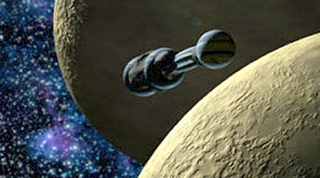 Crystal Palace is a typical modern Camelynian worldship made up of four
modules. The most forward module is the recreational and living spaces, comprising
a Dyson Sphere-style layout. The forward sphere spins around the ship's long
axis, providing 1.2G gravity along the inside surface of the sphere. This area
features living spaces (castles, plantations, and mansions, for the most part),
tournament and training fields, and farmland. Light is provided by artificial means,
mounted in the zero-G area at the center of the forward sphere. More than 1000 meters
in diameter, the sphere interior could be mistaken for a planet's surface.
Crystal Palace is a typical modern Camelynian worldship made up of four
modules. The most forward module is the recreational and living spaces, comprising
a Dyson Sphere-style layout. The forward sphere spins around the ship's long
axis, providing 1.2G gravity along the inside surface of the sphere. This area
features living spaces (castles, plantations, and mansions, for the most part),
tournament and training fields, and farmland. Light is provided by artificial means,
mounted in the zero-G area at the center of the forward sphere. More than 1000 meters
in diameter, the sphere interior could be mistaken for a planet's surface.
The second module, known as the Command Module, is cylindrical in shape and about
500 meters long. The command module is the most modern portion of a Camelynian
worldship, mounting six warp nacelles capable of driving the worldship up to warp 5.
Crystal Palace's CM is the area of the ship most familiar as part of a
functional starship, and also stores the ship's reserve oxygen and other consumables.
Crystal Palace also houses six squadrons of short-range Camelynian fighters
and bombers, which are deployed and serviced from the CM.
The aft two modules are actually a combined module about 1500 meters long. Sometimes
referred to as the "Memory Module", the worldship's aft spaces comprise a hemispherical
area containing plant and animal life from Camelyn. Much of the ship's atmospheric
processing is handled by the plantlife in the memory module, and the area could be mistaken
for an enormous outdoor park on a planet's surface. The remainder of the memory module
is given over to automated manufacturing, stasis chambers, computer control systems, and
library and consumables storage. A fully stocked Camelynian worldship is capable of
supplying the needs of nearly 10,000 sentients for almost a century with no resupply.
Crystal Palace is very much Task Group 5.4's breadbasket and resupply point.
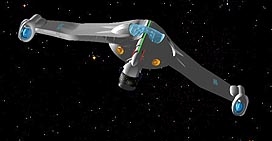 Crystal Palace is escorted and defended by two Camelynian Sword class destroyers,
C.S. Rising Star and C.S. Javelin. Though they are
called destroyers by the Camelynians, both ships are about 500 meters long with a
wingspan of more than 600 meters, making both cruisers in actual fact if not name.
Rising Star and Javelin are reminiscent of Rihannsu ships; Camelynians
learned much of what they know of space travel from observing (and in some cases,
capturing) Rihannsu ships over several hundred years. Camelynians are a big reason
why the Rihannsu now generally self-destruct their ships rather than allow their
capture by enemy forces.
Crystal Palace is escorted and defended by two Camelynian Sword class destroyers,
C.S. Rising Star and C.S. Javelin. Though they are
called destroyers by the Camelynians, both ships are about 500 meters long with a
wingspan of more than 600 meters, making both cruisers in actual fact if not name.
Rising Star and Javelin are reminiscent of Rihannsu ships; Camelynians
learned much of what they know of space travel from observing (and in some cases,
capturing) Rihannsu ships over several hundred years. Camelynians are a big reason
why the Rihannsu now generally self-destruct their ships rather than allow their
capture by enemy forces.
Like all Camelynian ships, Rising Star and Javelin are both overpowered
and overweaponed, in this case with plasma disruptors and mortars. As with much of
the rest of Camelynian engineering, the ships rely on brute force rather than
maneuverability and are virtually unstoppable by anything less than a full-size
dreadnought. Camelynian ships are vulnerable to fighter attacks, however, and
generally travel with a fair-size fighter escort. Sword class destroyers are unusual
in that they have a large crew recreation facility at their "waists" that is open to
starlight and can be artificially lighted. Camelynians insist on large, natural-looking
areas for recreation and training.
Additional Camelynian ships have joined the group on two occasions. U.S.S. Vanguard
was escorted by Camelynian destroyers C.S. Rapier and C.S. Sabre,
which joined the Crystal Palace escort forces. In November 2401, ten new Camelynian
ships entered M64 through the Hayashi hypergate, searching for Duke Henry Gaveston-Tudor,
the leader of the Camelynian contingent. This new group of ships, known as "Task Group
Lion," was centered around a Camelynian Hammer of Justice class carrier, the C.W.
King Lan DuLac. Camelynian carriers are similar to, but about one-quarter the
size of worldships, concentrating on the ability to deploy eight full squadrons of Camelynian
fighters and bombers, their internal living spaces, and an enormous weapon of mass
destruction capable of destroying worldship-size starships or even small planets! They lack
the long-term field capability and manufacturing capabilities of their worldships, and
require frequent resupply. The DuLac battlegroup includes a Camelynian cruiser
(C.W. Queen Monique Lehman DuLac), four Camelynian destroyers (Fire
Lance, Justicar, Phoenix, Hunter), two
Camelynian frigates (Humility, Chivalry), a transport (C.W.
Shining Bard) and a resupply ship for the carrier.
Finally, the task group includes three support ships. The first of these is M.R.F.
Pearl, NS-1938, a Mobile Repair Facility or "Merf" (MRF) as they are
affectionately known. MRFs are space-going docking frames large enough to accomodate
a Starfleet heavy cruiser. Every MRF has a single warp nacelle and a control and
living module attached and can reach speeds of up to warp 6. MRFs are always attended
by small "tender" ships and tugboats. Pearl, in particular, has a pair of
Atlas class Tugs associated with her as well as her standard tenders.
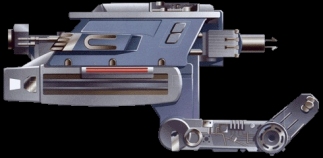 An Atlas class Tug is about 60 meters long and about 30 high and is geared to one thing:
pulling weights much larger than themselves. A single Atlas class tug can tow a ship
as large as a light cruiser single-handedly. Twelve of them can move an Ournal class
starbase. Task Group 5.4's two Atlases are sufficent to move any ship in the group
except Crystal Palace and Stirling at speeds of up to warp 2, and they
can tow the smaller ships at even greater speeds. Atlases are also used to move large
repair parts, such as full nacelles or Katana class saucer segments around Pearl.
An Atlas class Tug is about 60 meters long and about 30 high and is geared to one thing:
pulling weights much larger than themselves. A single Atlas class tug can tow a ship
as large as a light cruiser single-handedly. Twelve of them can move an Ournal class
starbase. Task Group 5.4's two Atlases are sufficent to move any ship in the group
except Crystal Palace and Stirling at speeds of up to warp 2, and they
can tow the smaller ships at even greater speeds. Atlases are also used to move large
repair parts, such as full nacelles or Katana class saucer segments around Pearl.
Task Group 5.4 also includes two freighters, one part of Starfleet, the other not. Many
such freighters were drafted into active task groups to provide repair parts, consumables
storage, and other logistical needs.
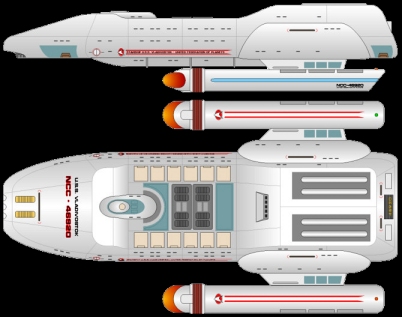 The larger of the two freighters is U.S.S. Vladivostok, NCC-46920, a Marco
Polo class freighter. Designed in the early 2330s, Marco Polos have remained virtually
unchanged over the last 70 years, gaining only advanced cryogenic dueterium drives
in the interim. They were the first freighter class to be armed with modern force
recoupling phasers, but even a modern runabout outguns a Marco Polo, whose weapons are
mostly useful for clearing interstellar debris and warding off pirates. Vladivostok
is essentially a flying cargo ship, with a top speed of warp 8, six decks, and 12 cargo
bays of various sizes. She is about 200 meters long and about 40 high. Vice Admiral
Aldur ordered this ship modified to serve as an additional resupply and rearming point
for the Wraith squadron. Other than this, Vladivostok is an unglamorous but
necessary part of Starfleet life. The ship is skippered by Lieutenant Lloyd Mason of
Atlanta, on Earth.
The larger of the two freighters is U.S.S. Vladivostok, NCC-46920, a Marco
Polo class freighter. Designed in the early 2330s, Marco Polos have remained virtually
unchanged over the last 70 years, gaining only advanced cryogenic dueterium drives
in the interim. They were the first freighter class to be armed with modern force
recoupling phasers, but even a modern runabout outguns a Marco Polo, whose weapons are
mostly useful for clearing interstellar debris and warding off pirates. Vladivostok
is essentially a flying cargo ship, with a top speed of warp 8, six decks, and 12 cargo
bays of various sizes. She is about 200 meters long and about 40 high. Vice Admiral
Aldur ordered this ship modified to serve as an additional resupply and rearming point
for the Wraith squadron. Other than this, Vladivostok is an unglamorous but
necessary part of Starfleet life. The ship is skippered by Lieutenant Lloyd Mason of
Atlanta, on Earth.
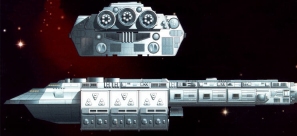 The second freighter in the group is Yamashita Maru, under Yoshiro Mori,
vessel master. Yamashita is a standard Antares class freighter and until
recently, part of the Starfleet merchant marine. This freighter is completely unarmed,
has no sensors of note, and has a maximum speed of warp 4. Much of the crew was
evacuated in the Hayashi system, but when it became clear that even the fastest ships
would be unable to escape the supernova, Yamashita and her supplies were sent
through the gate with the other ships. The crew has since been returned.
The second freighter in the group is Yamashita Maru, under Yoshiro Mori,
vessel master. Yamashita is a standard Antares class freighter and until
recently, part of the Starfleet merchant marine. This freighter is completely unarmed,
has no sensors of note, and has a maximum speed of warp 4. Much of the crew was
evacuated in the Hayashi system, but when it became clear that even the fastest ships
would be unable to escape the supernova, Yamashita and her supplies were sent
through the gate with the other ships. The crew has since been returned.
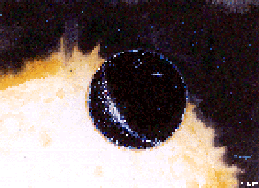
Task Group 5.4 is trapped in the galaxy known in the Milky Way as M64, the "Black Eye"
galaxy, for the dark portions which obscure part of the core. A relatively small galaxy
by such standards, M64's core is between 3,000 and 6,000 light-years in diameter, and
lies at the center of a galaxy of about 40,000 light-years total diameter. The destroyed
Traxati hypergate lies in orbit of a red giant star nicknamed "Gateway" by the group, and
lies about 8,000 light-years from galactic center.
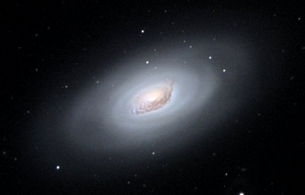 As stated earlier, M64 is 19,000,000 light-years from the Milky Way, and in the likelihood
that Task Group 5.4 is trapped here forever, Vice Admiral Aldur has already decided that
Gateway will be placed on the border between the new "Alpha" and "Beta" quadrants, in a
position similar to the one that Sol holds in the Milky Way. Presumably out of hope for
luck, Aldur has further declared that the majority of initial exploration will be done in
the new "Alpha" Quadrant... with the primary goal of Task Group 5.4 being to find another
Traxati gateway here: one that can take us home. Many in the group are hopeful that such
a gate can be found, and that it will be nearby. After all, fewer than 1000 light-years
separates the site of the former Hayashi system and the gates in Brimstone and Wormwood.
As stated earlier, M64 is 19,000,000 light-years from the Milky Way, and in the likelihood
that Task Group 5.4 is trapped here forever, Vice Admiral Aldur has already decided that
Gateway will be placed on the border between the new "Alpha" and "Beta" quadrants, in a
position similar to the one that Sol holds in the Milky Way. Presumably out of hope for
luck, Aldur has further declared that the majority of initial exploration will be done in
the new "Alpha" Quadrant... with the primary goal of Task Group 5.4 being to find another
Traxati gateway here: one that can take us home. Many in the group are hopeful that such
a gate can be found, and that it will be nearby. After all, fewer than 1000 light-years
separates the site of the former Hayashi system and the gates in Brimstone and Wormwood.
In the meantime, there is a brand new galaxy... with brand new dangers and opportunities...
to explore.
Once you're done here, tap
Back
to return to the Coronado Setting information index or the
Return
key at the bottom of your PADD, and you will be returned to the main index.
|






 Star Trek®,
Star Trek: The Next Generation®, Star Trek: Deep Space Nine®, and Star Trek: Voyager®
are registered trademarks of Paramount Pictures
in the United States Patent and Trademark Office. Use of this site constitutes your
acceptance of these terms of use.
Star Trek®,
Star Trek: The Next Generation®, Star Trek: Deep Space Nine®, and Star Trek: Voyager®
are registered trademarks of Paramount Pictures
in the United States Patent and Trademark Office. Use of this site constitutes your
acceptance of these terms of use.
 © Copyright 2002,