
 Federation technology has been advancing steadily for the last two hundred years in a variety of
areas, including information, medical, defensive, and recreational technologies. This database
will take you through some of the more important areas of Federation and Starfleet technology.
With the century soon coming to an end, it's important to take a look back at all the developments
in the last 100 years. Even if you are a veteran Starfleet officer, you may find something useful
or interesting in the information below!
Federation technology has been advancing steadily for the last two hundred years in a variety of
areas, including information, medical, defensive, and recreational technologies. This database
will take you through some of the more important areas of Federation and Starfleet technology.
With the century soon coming to an end, it's important to take a look back at all the developments
in the last 100 years. Even if you are a veteran Starfleet officer, you may find something useful
or interesting in the information below!
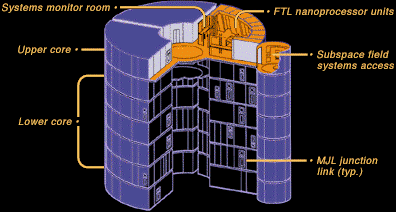 Probably the single most important advance in the last century has been the development of
faster-than-light isolinear computing. This single factor has had a tremendous impact on virtually
every other element of Federation technology. Tricorders, sensors, weapons systems, holodecks,
transporter pattern buffers... all of them were built or rebuilt around FTL computer technology.
FTL computing technology replaces the previous generation duotronic, multitronic, and transtator-based
computing and operational systems. The new systems use optical or bioneural waveguides to transmit
computer information at faster-than-light speeds through a subspace distortion field.
Probably the single most important advance in the last century has been the development of
faster-than-light isolinear computing. This single factor has had a tremendous impact on virtually
every other element of Federation technology. Tricorders, sensors, weapons systems, holodecks,
transporter pattern buffers... all of them were built or rebuilt around FTL computer technology.
FTL computing technology replaces the previous generation duotronic, multitronic, and transtator-based
computing and operational systems. The new systems use optical or bioneural waveguides to transmit
computer information at faster-than-light speeds through a subspace distortion field.
Because these computer have no moving parts, there is virtually no wear and virtually no degradation in storage, even over long periods. For instance, there are reliable records of personnel surviving more than five decades in a modern transporter pattern buffer! Instantaneous phase replication of computer cores has allowed these systems a near perfect record for reliability. Even in the unlikely event of a complete systems failure, the backup system will assume control of the data and transfer of information with no loss in service.
 A nearly equally important advance is in the development of light, high-storage capacity isolinear
optical chips. This allows reliable storage of enormous quantities of information. In fact, most
computers no longer rely on a separate "memory" storage -- the memory is in the form of quickly
replaceable isolinear chips, which can be also be removed and stored if needed.
A nearly equally important advance is in the development of light, high-storage capacity isolinear
optical chips. This allows reliable storage of enormous quantities of information. In fact, most
computers no longer rely on a separate "memory" storage -- the memory is in the form of quickly
replaceable isolinear chips, which can be also be removed and stored if needed.
A third important development is the recent upgrades in data transfer through the use of bioneural gel packs. These packs, using synthetically produced brain and neuro-transmitter cells, allow virtually instantaneous transfer of data from widely separated points in a ship or other facility. Response times of computers using the gel packs is tremendously increased over any other available technology. These bioneural gel packs can be further advanced with biometric technology, which allows processing of information in a much more "natural" way -- the system predicts what data will be called for next and has it available even before it's asked for!
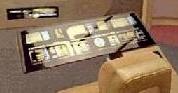 An advance made possible by the developments in FTL computing has been the new series of
object-based programming languages. Though object-based computing has been available since the
late 20th century, the latest models offer unlimited flexibility, allowing any console to
display virtually any function available in the computer's storage. Consoles can even
remember and instantly reconfigure to preferred settings for each operator, and will
reset to those settings when a new operator arrives.
An advance made possible by the developments in FTL computing has been the new series of
object-based programming languages. Though object-based computing has been available since the
late 20th century, the latest models offer unlimited flexibility, allowing any console to
display virtually any function available in the computer's storage. Consoles can even
remember and instantly reconfigure to preferred settings for each operator, and will
reset to those settings when a new operator arrives.
These advances directly influenced a new series of sensor capabilities. Older duotronic sensor systems were relatively limited, being able to scan along a single axis, or along all axes with a much reduced resolution. Combined with the large footprint of older style sensor systems rendered most starships and starbases unable to carry more than two or three sensor arrays. Usually two were carried, a single multi-axis system and a single single-axis system used as a navigational and long range sensor.
Modern sensor systems are much more capable, with even relatively modest starships being able to carry an assortment of sensor systems in a variety of scanning regimens. Along with the standard sensors able to sense electro-magnetic radition and gravitation, modern sensors can detect subatomic particles, subspace variances, energy fluxes, and a much wider assortment of stellar and planetary phenomenon than was possible only a few decades ago.
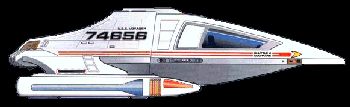 Miniturization has also helped us cross the final frontier! Warp engines continue to get
smaller and smaller, so that even shuttlecraft today can be equipped with quite modern warp
engines and nacelles, capable of driving them to speeds of warp 9! Larger shuttles can cruise
for weeks or even months on these engines thanks to advances in warp engine efficiency.
Miniturization has also helped us cross the final frontier! Warp engines continue to get
smaller and smaller, so that even shuttlecraft today can be equipped with quite modern warp
engines and nacelles, capable of driving them to speeds of warp 9! Larger shuttles can cruise
for weeks or even months on these engines thanks to advances in warp engine efficiency.
In basis, though, warp drive has changed very little in the last two centuries, since the advent of using dilithium crystals to control the reaction. Matter and antimatter are still mixed in an intermix chamber to produce a non-explosive reaction that creates a tremendous amount of energy. That energy is regulated by the dilithium crystals to produce warp plasma. That plasma is then routed to either the engines, generating the warp field, or to the electro-plasma systems of a modern starship, starbase, or planetary power facility, to generate power. Though the basic techniques have not changed, the size of the components used to make this possible have come down tremendously in the last fifty years.
 Another advance made possible by the incredibly small components involved in FTL computing and
the related advances in sensor capability is a new generation of tricorders. The latest
scientific tricorders have a range of several hundred meters, and can be programmed and
reprogrammed to detect virtually anything that a starship's main sensor arrays can search for.
They are also quite easy to use, requiring very little training. Communications are also
provided through a miniture subspace transceiver, allowing the tricorder to link with much
larger computer systems and utilize their processing capabilities on the data collected.
Another advance made possible by the incredibly small components involved in FTL computing and
the related advances in sensor capability is a new generation of tricorders. The latest
scientific tricorders have a range of several hundred meters, and can be programmed and
reprogrammed to detect virtually anything that a starship's main sensor arrays can search for.
They are also quite easy to use, requiring very little training. Communications are also
provided through a miniture subspace transceiver, allowing the tricorder to link with much
larger computer systems and utilize their processing capabilities on the data collected.
Similarly, medical tricorders are much more sensitive, and can be used to make an accurate diagnosis of a variety of conditions. The large storage capabilities of a modern tricorder make it a mobile encyclopedia and medical reference.
If scanning capabilities are not required, these storage capabilities can be transferred to a larger, more readable screen and control surfaces similar to a modern computer console. The result is called a Personal Access Display Device, or PADD. PADDs are umbiquitous in the modern world as personal organizers, data readers, and mobile display units. An enormous amount of information can be stored on a single PADD, and many people modify theirs still further with an isolinear chip reader for both additional storage and backup capabilities.
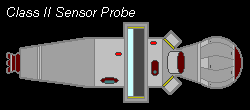 The same miniturization that makes the latest tricorders so effective has also been applied to
starship-based sensor systems in the form of sensor probes. No longer is it necessary to send
a full shuttlecraft or starship to investigate possibly dangerous phenomenon. Modern sensor
probes can match the capabilities of all but the most effective sensor arrays and return that
data for analysis to the launch vehicle.
The same miniturization that makes the latest tricorders so effective has also been applied to
starship-based sensor systems in the form of sensor probes. No longer is it necessary to send
a full shuttlecraft or starship to investigate possibly dangerous phenomenon. Modern sensor
probes can match the capabilities of all but the most effective sensor arrays and return that
data for analysis to the launch vehicle.
Subspace communications capabilities also continue to improve, with speeds exceeding warp 9.9999, or more than 200,000 times the speed of light, being common. Subspace transceiver arrays have been constructed across the Federation that can pick up and relay messages quickly and efficiently. The increase in communications speed combined with the sensor capabilities in probes means that remote outposts no longer need to be built to monitor Threat force borders in many cases. A line of sensor probes can often serve the same function, and such a line has been constructed across the border between the Federation and the Romulan Star Empire as a pilot.
Communications have also improved at the personal level, with communicators now miniturized to the size of small brooches, which are often worn on one's person. These smaller communicators offer the same features as the much larger models of the last century, including planetary and off-planet communications, long battery life, emergency locator beacons, and individual security locking of both the communicator and transmissions to or from it.
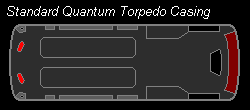 Communications are not the only area to benefit from miniturization. The latest Federation
weapons systems have also vastly improved in the last two hundred years. The latest Starfleet
missile weapons include the quantum torpedo. Earlier photon torpedoes required the loading of
1.5kg of antimatter into the warhead -- often a dangerous process. For this reason among others,
photon torpedoes have been largely retired by Starfleet.
Communications are not the only area to benefit from miniturization. The latest Federation
weapons systems have also vastly improved in the last two hundred years. The latest Starfleet
missile weapons include the quantum torpedo. Earlier photon torpedoes required the loading of
1.5kg of antimatter into the warhead -- often a dangerous process. For this reason among others,
photon torpedoes have been largely retired by Starfleet.
Quantum torpedoes take advantage of the destructive nature of a phenomenon in normal space -- the quantum filament. A quantum filament is a subatomic object that can be kilometers long, but possesses almost no mass. A quantum torpedo warhead is loaded with 25 to 50 filaments of an average length of 100 meters. When the torpedo detonates, the filaments shred the torpedo casing explosively and are, in effect, dispersed as subatomic shrapnel travelling at relativistic speeds. Few starship shields or hulls can cope with such a concentrated destructive force.
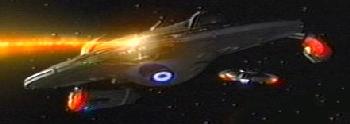 Starship-based phaser weapons systems have also been vastly improved in the last two centuries.
The latest phaser designs use mutliple phaser collimators to concentrate an extremely strong
phased directed energy discharge to the target. Phasers can be set to continuous fire or pulse
fire as needed. A phaser cannon system is also under development.
Starship-based phaser weapons systems have also been vastly improved in the last two centuries.
The latest phaser designs use mutliple phaser collimators to concentrate an extremely strong
phased directed energy discharge to the target. Phasers can be set to continuous fire or pulse
fire as needed. A phaser cannon system is also under development.
Modern phaser emitters are nearly impossible to overheat, and can sustain energy discharges exceeding 7MW almost indefinitely. Part of this capability comes from the collimator's ability to shift the focus point of the fire along the collimator strip, allowing each section of the strip to cool in sequence. However, the emitters themselves are also much more durable and resistant to wear.
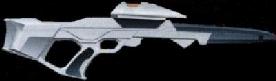 Of course, these concepts have also filtered down to hand-held phaser weaponry, which has also
benefitted from the advances in miniturization. New saurium krellide power cells hold an
extremely high charge for extended periods of time, allowing for a powerful weapon, accurate
weapon that requires little training.
Of course, these concepts have also filtered down to hand-held phaser weaponry, which has also
benefitted from the advances in miniturization. New saurium krellide power cells hold an
extremely high charge for extended periods of time, allowing for a powerful weapon, accurate
weapon that requires little training.
Modern emitters deliver an extremely accurate beam of energy at long range, which can be altered at the source for a variety of purposes. Modern phasers can stun humanoid lifeforms, heat or disintegrate targets, deliver energy to technological systems over long range, or even deliver highly miniturized particle or projectile weapons! They also hold sufficient charge for extended periods of use without recharging.
These modern emitters are also being used in the latest shielding and tractor beam systems. No longer does a starship hull have to rely on a mesh of diburnium-osmium alloy to maintain structural integrity. This capability can now be delivered with purely virtual annular forcefield technology. These fields, referred to as "structural integrity fields," or SIFs, help in holding the extremely massive starships of our day together under the tremendous stress of impulse or warp flight. Of course, Inertial Dampening Fields, or IDFs, are still in use to help counteract the tremendous accelerations involved in starflight. Unfortunately, they still possess their characteristic lag, which sometimes results in a "bumpy" ride when unexpected acceleration occurs.
These same annular forcefields can be directed into one-way fields for shuttlebays and airlocks, can generate artificial gravity, or even containment fields to isolate dangerous chemicals or lifeforms from the scientists or Starfleet officers studying them. Forcefields are of course still used in penal facilities and where protective measures are needed.
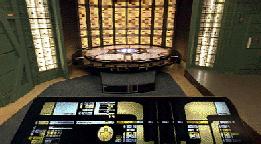 Modern transporters have also benefitted from both miniturization and the advent of extremely
precise scanning beams and forcefields. The occurance of transporter-related mishaps has
dropped to 1 per 100,000 transports, the vast majority of which are non-fatal. Range and
resolution have also both increased dramatically, and modern transporter pattern buffers can
store information almost indefinitely with no loss of information. Under certain circumstances,
with transporter relays in place, or a highly reactive substance to lock onto, a modern
transporter field can even be extended over more than a light-year!
Modern transporters have also benefitted from both miniturization and the advent of extremely
precise scanning beams and forcefields. The occurance of transporter-related mishaps has
dropped to 1 per 100,000 transports, the vast majority of which are non-fatal. Range and
resolution have also both increased dramatically, and modern transporter pattern buffers can
store information almost indefinitely with no loss of information. Under certain circumstances,
with transporter relays in place, or a highly reactive substance to lock onto, a modern
transporter field can even be extended over more than a light-year!
Of course, the basis of the transporter has changed very little, and is one of the technological achievements upon which the Federation is based. Transporters involve the conversion of matter into energy, and the transmission of that energy to a remote location, where the material object being transported is rematerialized, usually in only a few seconds. From the remote observer's perspective, the object or person being transported disappears from the transporter pad, reappearing where the operator desires.
Transpoters are used today not only for personnel and cargo storage, but even for long-term storage of relatively simple objects for transfer into holographic environments. Coffee is an excellent example. Because coffee has such a simple pattern, it can be stored within the ship's data network and reproduced at will.
This technology is referred to as replication, and has dramatically reduced the amount of consumables that a starship, starbase, or colony must retain on site. Because virtually any object or foodstuff can be reproduced from its data pattern, a sizable menu of choices is available from the replicators, including the top choices of chefs all over the Federation!
 These extremely accurate transporters and forcefields have even been applied recreationally!
The latest starships, starbases, and recreational and educational facilities include holodecks.
Within a holodeck, an extremely realistic artificial environment can be created for a variety
of purposes. These simulations are virtually indistinguishable from reality, and allow the
visitor to experience cultures, environments, or activities that they would not normally be
able to experience. The holodeck computers can even take advantage of the extremely high
speeds of FTL computing technology to create lifelike characters to inhabit the holographic
environments! Biometric circuitry was originally developed for holodeck use; holodecks based
on this system can create environments that are virtually indistinguishable from
reality, right down to their characters.
These extremely accurate transporters and forcefields have even been applied recreationally!
The latest starships, starbases, and recreational and educational facilities include holodecks.
Within a holodeck, an extremely realistic artificial environment can be created for a variety
of purposes. These simulations are virtually indistinguishable from reality, and allow the
visitor to experience cultures, environments, or activities that they would not normally be
able to experience. The holodeck computers can even take advantage of the extremely high
speeds of FTL computing technology to create lifelike characters to inhabit the holographic
environments! Biometric circuitry was originally developed for holodeck use; holodecks based
on this system can create environments that are virtually indistinguishable from
reality, right down to their characters.
In a holodeck, you can visit Renaissance England, play chess with renouned Grandmasters from the last thousand years, practice martial arts, or view sporting events or plays. Alternately, you can even cast yourself in the starring role in a "holo-novel" -- placing you into the action of either your favorite novels, or unique situations developed on the fly by the computer. Visitors can come alone, or in as large a group as the holodeck will accomodate to jointly experience the simulation.
Because the simulation is built from holograms and extremely precise use of forcefields and tractor beams, dangerous situations in the holodeck cannot hurt visitors unless the "safety protocols" guiding the simulation are disabled. This procedure can be extremely hazardous -- jumping off a holographic 100 meter cliff will most likely kill you just as effectively as a real one...
 Amazingly, the character databases in modern holographic systems are so advanced that an
Emergency Medical Hologram, or EMH, has been developed! This holographic doctor can diagnose
problems, treat injuries, and even perform surgery. Though the bedside manner of this "doctor"
leaves something to be desired, he can be installed and used in the remotest of areas.
Because he is a hologram, he can also be instantly transferred to the location of injured
personnel, much faster than a person. Holographic engineers, also under development, can work
in radiation-saturated areas or the vacuum of space without the special protection needed
by a biological lifeform. Additionally, there are also experiments being conducted with
various types of holographic internal defense for starships and starbases, as well as
holographic command interfaces for the ship itself.
Amazingly, the character databases in modern holographic systems are so advanced that an
Emergency Medical Hologram, or EMH, has been developed! This holographic doctor can diagnose
problems, treat injuries, and even perform surgery. Though the bedside manner of this "doctor"
leaves something to be desired, he can be installed and used in the remotest of areas.
Because he is a hologram, he can also be instantly transferred to the location of injured
personnel, much faster than a person. Holographic engineers, also under development, can work
in radiation-saturated areas or the vacuum of space without the special protection needed
by a biological lifeform. Additionally, there are also experiments being conducted with
various types of holographic internal defense for starships and starbases, as well as
holographic command interfaces for the ship itself.
Additional emergency support holograms are also being developed, specifically in the Engineering and Security disciplines. Holograms for these purposes have many advantages. In particular, they can be sent into extremely dangerous locations where a sentient would not be able to go, work in battle zones without fear of death, or act as decoys to allow the escape of sentients in the area.
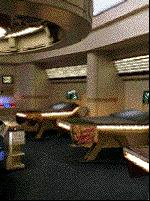 Other medical technology has advanced almost as quickly as the technology in other areas
of the Federation, and in some ways, it has advanced faster. A modern scanning biobed is
now a virtually required feature in sickbays, infirmaries, and hospitals throughout the
Federation and Starfleet. Biobeds allow for near-instant diagnosis of a variety of
problems, often not even requiring a physician to interpret the data.
Other medical technology has advanced almost as quickly as the technology in other areas
of the Federation, and in some ways, it has advanced faster. A modern scanning biobed is
now a virtually required feature in sickbays, infirmaries, and hospitals throughout the
Federation and Starfleet. Biobeds allow for near-instant diagnosis of a variety of
problems, often not even requiring a physician to interpret the data.
These biobeds can be equipped with surgical frames very quickly to allow doctors to perform surgery without the risk of infection or contamination of the site. They continuously monitor the patient's condition, and display that information for the doctor's review at a moment's notice. The latest pharmecuticals and techniques are available virtually everywhere, even in remote locations, thanks to replication technology and information transfer. No longer is it necessary to travel far from home to receive the latest care!
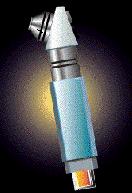 Finally, the delivery of drugs is much simplified by the modern hypospray. These devices
use a charge of compressed air to deliver their contents into the bloodstream without
piercing the skin. Modern hyposprays can be set to deliver any quantity of the substance
in their vials, and these vials can be changed out in just a few seconds. Further, there
is no need to clean a hypospray between uses -- the contents of one vial will be cleared
from the hypo when the vial is removed without intervention from the user.
Finally, the delivery of drugs is much simplified by the modern hypospray. These devices
use a charge of compressed air to deliver their contents into the bloodstream without
piercing the skin. Modern hyposprays can be set to deliver any quantity of the substance
in their vials, and these vials can be changed out in just a few seconds. Further, there
is no need to clean a hypospray between uses -- the contents of one vial will be cleared
from the hypo when the vial is removed without intervention from the user.
In addition to specifying the amount to deliver, the hypo can also be programmed for timed release over several seconds, and varying spray densities. In an extreme situation, hypos have even been used as close range weapons, delivering either gas at range, or sedatives to opponents touched with them.
This concludes the technical information database. If you have any questions about any of the information in this file, please feel free to contact the database administrator. Additionally, if you have suggestions for additional topics that can be added, please send them along! We're always looking for ways to make this information more useful and valuable. Thank you for taking the time to review it!
Once you're done here, tap Back to return to the Coronado Setting information index or the Return key at the bottom of your PADD, and you will be returned to the main index.





 © Copyright 2002,