
| History of Ships Named U.S.S. Coronado | |
|
U.S.S. Coronado, NCC-97901, was the second Katana class frigate constructed
by the Utopia Planitia Fleetyards, Sol IV, but the first such ship launched overall.
This is not a particularly unusual situation when a new starship type is developed and
launched. Coronado was constructed concurrently with the class ship, U.S.S.
Katana; construction time was just over six years from the date of the first gamma
weld. However, Coro was able to take advantage of several refinements that were
made to the Katana during her shakedown cruise, and was therefore launched just
prior to the class ship. This modern starship is the fifth Starfleet vessel to be
called Coronado. U.S.S. Coronado, Starfleet Registry NCC-97901, was commissioned on Stardate 239907.26. Her motto is traditional to all Earth-based ships named Coronado since the 20th century, and reads: "Forever the leader... forever Coronado." In the early 21st century, Coronado was a warship -- the command and control ship of the United States Navy Third Fleet, and was based in San Diego, CA.
It was an image that people all across North America would not soon forget. From that day forward, ships named Coronado have taken the motto of that United States Navy warship as their own... and "Always the leader," the motto of U.S.S. Coronado, AGF-11, became "Forever the leader."
Starfleet vessels named Coronado have generally been frigates or light cruisers, and the first was no exception. However, the first ship named U.S.S. Coronado "in Starfleet" wasn't a Starfleet vessel at all. The Durance class frigate U.S.S. Coronado, FR-254, was commissioned by the United Earth Space Probe Agency (UESPA), the immediate precursor to Starfleet.
FR-254 was decommissioned in 2184, and therefore did not see service in the Four Years War with the Klingon Empire. In fact, the next Coronado in Starfleet service was not commissioned until nearly a century later, in 2273. U.S.S. Coronado, NCC-2725, was part of the "cities" series of Akyazi class frigates.
Most of the crew was killed, but the remainder fought back. Communications with both Starfleet and the Empire were cut off, and Coro's crew found themselves in a protracted battle with the renegades. They were eventually successful in killing the renegades and retaking their ship. Coro herself was badly damaged, however, and later had to be scrapped. Ironically, the renegade's vessel took Coro's place on the evacuation line.
Brought into action in the B'narax sector near Starbase 375, Coronado was immediately made part of the group tasked to capture the Chynoweth system from the Cardassians. The Starfleet group was successful, and held the Chynoweth system for 24 days. The counter-offensive, when it came, was made up almost exclusively of the brand new (at that time) Cardassian Galor class attack cruiser. Cardassian ships were, one-to-one, more than a match for their Starfleet counterparts until well into the 2360s. Starfleet had never before faced a foe that concentrated on such a low number of extremely capable attack vessels until the Cardassian War, and the repeated and continued losses the Federation faced in that war were a testament to that. The second battle for Chynoweth was no exception, and the relatively few number of Galors that entered that system crushed the Starfleet group. Coronado was destroyed in the first exchange of fire. Her total time in service, from commissioning, to her destruction in the Chynoweth system: 41 days. The Chynoweth system was held by the Cardassians until the late stages of the Dominion War in 2375, and Starfleet didn't produce a vessel that was a match for the Galor class until the introduction of the Galaxy class in 2361.
New Orleans class frigates carried Marine companies as a matter of course. Coro carried no fewer than six platoons for most of her term in Starfleet. Less than two years after her commissioning, this helped U.S.S. Coronado avenge her prior namesake through the intact capture of the Cardassian Galor class warship Briagor in 2364. This action earned her Captain and senior staff the Federation Medal of Valor. Much of the knowledge that allowed Starfleet to break the impasse in the Cardassian War over the next three years is directly attributable to the capture of that ship's databanks. The ship's CO at that time: then-Fleet Captain Alynna Nechayev. She later went on to become the Starfleet Commander in Chief.
The newest U.S.S. Coronado is one of the most advanced starships in the 'fleet. Taking advantage of several new technologies in both starship defense and propulsion, the Katana class may be the beginning of a new resurgence in starship design. Though not a ship built for her crew comforts, she incorporates several new design philosophies.
The Katana class has been controversial since it first appeared as a speculative design study at Utopia Planitia Fleet Yards more than 20 years ago. There are some that sarcastically refer to Coro and her sister ships as the "24th century 'Great Experiment,'" linking them to the failed first attempt to harness transwarp velocities in the Excelsior class more than a century ago. As the first Katana class ship out of the 'yard, Coro has to not only prove herself, but the utility of the rest of the class as well.
If Coronado and her sisters can pull the experiment off, the Katana class could well become her age's Excelsior. For now, four Katana class frigates have been ordered, all to be mounted with a quantum phase inversion matrix. Thanks to the multi-mission capability of the Katana, each has been fitted for a different mission profile. The Commanding Officer of this newest Coronado is Commander Tebrun Kor. Kor, previously a member of the Starfleet Secret Service and former Starfleet Intelligence team leader, is a highly decorated and experienced officer. He is also a former engineer with significant experience with many experimental propulsion technologies, including soliton wave propulsion and artificial singularities. As of Stardate 239906.24, the ship, Captain, and crew have been assigned to the Starfleet Intelligence division for a three year tour of duty. Once you're done here, tap Back to return to the Coronado information index or the Return key at the bottom of your PADD, and you will be returned to the main index. | |
| The U.S.S. Coronado model was created by Ryan McClure. The Katana class design was created by Rick Sternbach, and appeared in the ST:TNG Technical Manual. It was modified for U.S.S. Coronado by Mark Kingsnorth, Fraser Deziel, and Ryan McClure. Reproduction or use of Coronado images in any form is strictly prohibited without the prior written authorization of the site author and digital modeller per this site's terms of use. The Durance, Akyazi, and Rigel class ships appeared as the Durance, Akuzi, and Monarch at Wolf 359, and are copyright 1997, Wolfpak. These images are used with the permission of the Wolfpak. |





 Star Trek®,
Star Trek: The Next Generation®, Star Trek: Deep Space Nine®, and Star Trek: Voyager®
are registered trademarks of Paramount Pictures
in the United States Patent and Trademark Office. Use of this site constitutes your
acceptance of these terms of use.
Star Trek®,
Star Trek: The Next Generation®, Star Trek: Deep Space Nine®, and Star Trek: Voyager®
are registered trademarks of Paramount Pictures
in the United States Patent and Trademark Office. Use of this site constitutes your
acceptance of these terms of use.
|
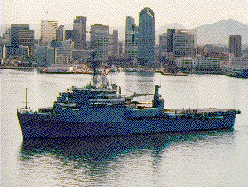 When the Hermosa quake struck in 2047, Coronado was docked at San Diego,
and coincidentally, was preparing to get underway. As the geologic disturbance
intensified, panicky civilians rushed the Marine guards and streamed aboard. The
Commanding Officer of the ships of the Third Fleet allowed the civilians on board,
and as the wrecked coastal geologic plate disappeared beneath the rising waves (the
area is now the site of a massive coral reef), he got Coronado and the ships
of the Third Fleet, loaded with civilian refugees, out away from the coast and to
safety. When the ships of the Third Fleet sailed into San Francisco Bay two days
later, Coronado in the lead, they were carrying the only survivors of the
quake from the San Diego area.
When the Hermosa quake struck in 2047, Coronado was docked at San Diego,
and coincidentally, was preparing to get underway. As the geologic disturbance
intensified, panicky civilians rushed the Marine guards and streamed aboard. The
Commanding Officer of the ships of the Third Fleet allowed the civilians on board,
and as the wrecked coastal geologic plate disappeared beneath the rising waves (the
area is now the site of a massive coral reef), he got Coronado and the ships
of the Third Fleet, loaded with civilian refugees, out away from the coast and to
safety. When the ships of the Third Fleet sailed into San Francisco Bay two days
later, Coronado in the lead, they were carrying the only survivors of the
quake from the San Diego area.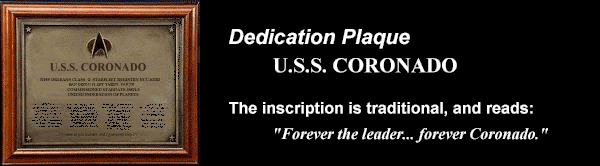
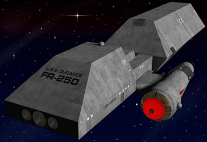 Commissioned in 2153, this Coronado carried a crew of 56 people and had a
maximum speed of warp 2 by today's standards. She was armed with two heavy lasers,
two missile launchers, and a nuclear torpedo launcher, making it one of the "muscle"
ships of its day. Ships of that time had only light navigational deflectors, no
shields, and no transporters. Coro distinguished herself in the Romulan War,
and when that war ended in 2160, she and her sister frigates became deterence patrol
vessels on the Romulan Neutral Zone. When the United Federation of Planets was
established a few years later, the UESPA ships were some of the first inducted into
the new government's Starfleet.
Commissioned in 2153, this Coronado carried a crew of 56 people and had a
maximum speed of warp 2 by today's standards. She was armed with two heavy lasers,
two missile launchers, and a nuclear torpedo launcher, making it one of the "muscle"
ships of its day. Ships of that time had only light navigational deflectors, no
shields, and no transporters. Coro distinguished herself in the Romulan War,
and when that war ended in 2160, she and her sister frigates became deterence patrol
vessels on the Romulan Neutral Zone. When the United Federation of Planets was
established a few years later, the UESPA ships were some of the first inducted into
the new government's Starfleet.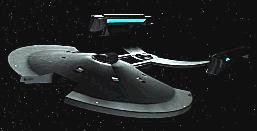 Built during Starfleet's "Great Awakening" following the successful return of
U.S.S. Enterprise from her five year mission in deep space, this Coronado
carried a crew of 76, and had a maximum speed of warp 7 by today's standards. The
Andorian design of the Akyazi class served Coro well, and she spent most of
her time in Starfleet patrolling the Klingon Neutral Zone. However, she was one
of the ships that participated in the evacuation of Qo'nos, which began in 2294.
Coro evacuated some 340,000 Klingon citizens before she was attacked and
boarded by a group of renegade Klingons in 2302.
Built during Starfleet's "Great Awakening" following the successful return of
U.S.S. Enterprise from her five year mission in deep space, this Coronado
carried a crew of 76, and had a maximum speed of warp 7 by today's standards. The
Andorian design of the Akyazi class served Coro well, and she spent most of
her time in Starfleet patrolling the Klingon Neutral Zone. However, she was one
of the ships that participated in the evacuation of Qo'nos, which began in 2294.
Coro evacuated some 340,000 Klingon citizens before she was attacked and
boarded by a group of renegade Klingons in 2302.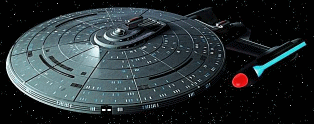 The most unlucky of the Starfleet vessels named Coronado has to be the Rigel
class Coro, NCC-62132. Commissioned in 2344, this vessel carried a crew of
155 and was a relatively modern starship, even by today's standards. She carried
three photon torpedo launchers, eight phaser banks, medium shields, and even a
small Marine company. Brought into service at the height of the Cardassian War,
Coro saw action almost immediately in that conflict.
The most unlucky of the Starfleet vessels named Coronado has to be the Rigel
class Coro, NCC-62132. Commissioned in 2344, this vessel carried a crew of
155 and was a relatively modern starship, even by today's standards. She carried
three photon torpedo launchers, eight phaser banks, medium shields, and even a
small Marine company. Brought into service at the height of the Cardassian War,
Coro saw action almost immediately in that conflict.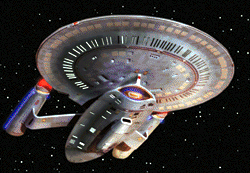 Conversely, the most successful of the past Coronados to date is NCC-63100, a
New Orleans class frigate commissioned in 2363. The Galaxy class heavy cruiser, the
Nebula class light cruiser, and the New Orleans class frigate were all ships that
were produced as a direct result of the Cardassian War of the 2340s and 2350s. Fast,
technologically advanced, and extremely survivable, these ships drove a renaissance in
starship design that continued well into the 2370s. The New Orleans class was the
lightest of the three, but perhaps the most capable in combat. Mounting 12 phaser banks,
three torpedo tubes, heavy shields, and capable of speeds well over warp 9, this Coro
played a vital part in ending both the Cardassian War and the Dominion War that came
later.
Conversely, the most successful of the past Coronados to date is NCC-63100, a
New Orleans class frigate commissioned in 2363. The Galaxy class heavy cruiser, the
Nebula class light cruiser, and the New Orleans class frigate were all ships that
were produced as a direct result of the Cardassian War of the 2340s and 2350s. Fast,
technologically advanced, and extremely survivable, these ships drove a renaissance in
starship design that continued well into the 2370s. The New Orleans class was the
lightest of the three, but perhaps the most capable in combat. Mounting 12 phaser banks,
three torpedo tubes, heavy shields, and capable of speeds well over warp 9, this Coro
played a vital part in ending both the Cardassian War and the Dominion War that came
later. Five years later, Coronado was under the command of then-Fleet Captain Brian
Aldur. It was later discovered by the Federation News Service that Coro,
under the guise of being in Starfleet Intelligence, was actually a "timeship." Mounted
with a highly experimental time-travel technology, Aldur had commanded no fewer than 17
temporal incursions in defense of the Federation. This technology was later removed
following the passage of the Temporal Prime Directive in mid-2375. Aldur also commanded
Coronado when she was named the command ship of the Second Fleet and participated
in Operation Rainbow Five, the offensive that ended the Dominion War. During that
operation, Coro got a chance to avenge her namesake again by recapturing the
Chynoweth system for the Federation.
Five years later, Coronado was under the command of then-Fleet Captain Brian
Aldur. It was later discovered by the Federation News Service that Coro,
under the guise of being in Starfleet Intelligence, was actually a "timeship." Mounted
with a highly experimental time-travel technology, Aldur had commanded no fewer than 17
temporal incursions in defense of the Federation. This technology was later removed
following the passage of the Temporal Prime Directive in mid-2375. Aldur also commanded
Coronado when she was named the command ship of the Second Fleet and participated
in Operation Rainbow Five, the offensive that ended the Dominion War. During that
operation, Coro got a chance to avenge her namesake again by recapturing the
Chynoweth system for the Federation.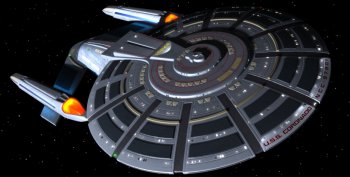 Capable of warp speeds well over warp 9 for extended periods, the Katana class is also
the first Starfleet vessel specifically designed for quantum slipstream travel. Her
Z-axis compression was selected for ease of such transits, and most Katana class
ships are not only able to generate slipstream conduits for themselves, but can
coordinate task groups and bring them through with the frigate. Coro also carries
10 phaser banks, three torpedo tubes, heavy shields, and two Marine companies. These
factors makes Coronado ideal for quick response to trouble spots.
Capable of warp speeds well over warp 9 for extended periods, the Katana class is also
the first Starfleet vessel specifically designed for quantum slipstream travel. Her
Z-axis compression was selected for ease of such transits, and most Katana class
ships are not only able to generate slipstream conduits for themselves, but can
coordinate task groups and bring them through with the frigate. Coro also carries
10 phaser banks, three torpedo tubes, heavy shields, and two Marine companies. These
factors makes Coronado ideal for quick response to trouble spots.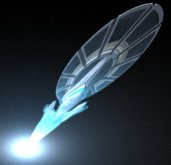 Even if the quantum slipstream experiment is a failure, however, Coronado's
defenders point to her other advances as sufficient reason to promote the class: her
endless reconfiguration options, her biometric computer circuitry, her tetroburnium
alloy hull, the holographic defense system. But it is upon that Holy Grail of
propulsion technologies, slipstream, that Utopia Planitia has pinned Coro's
hopes and dreams.
Even if the quantum slipstream experiment is a failure, however, Coronado's
defenders point to her other advances as sufficient reason to promote the class: her
endless reconfiguration options, her biometric computer circuitry, her tetroburnium
alloy hull, the holographic defense system. But it is upon that Holy Grail of
propulsion technologies, slipstream, that Utopia Planitia has pinned Coro's
hopes and dreams. © Copyright 2003,