
| Design of the Katana Class Starship | |
|
The purpose of this file is to allow someone who is completely unfamiliar with the
operating principles of the starship of the United Federation of Planets Starfleet
familiar with the basic design elements used in Federation starships. It is intended
for the novice user, but even experienced Starfleet Officers can benefit from a
periodic review of this information. If, after reviewing this information, you still
have questions, you are welcome to direct those questions to the Commanding Officer.
Because you are reviewing this file from the databanks of such a starship, this will be the model used. Note that individual ship designs (called "classes") may evidence minor variations from the information you are about to review. These variations are referred to as "flights." For detailed information about the major design differences between this ship class and the other major starship classes used by Starfleet, it is recommended that you review a copy of "Jayne's Fighting Starships."
Starfleet's frigates are heavily armed for their size, and are fast enough to serve as either escort ships or on reconnaissance missions. They often serve as heavy support for patrol destroyers and destroyer escorts along Neutral and Threat force borders. A single Katana class fig (frigates are sometimes affectionately referred to as "figs") can "backstop" as many as six to eight flights of Vigilant class patrol ships and their attendant Artemis class destroyers.
In the basic front view above, you can see these components. Most Federation Starfleet ships have this same basic forward silhouette, making Starfleet vessels some of the easiest to recognize in the Alpha quadrant. Many other races in our galaxy also have basic "signature" designs that make their ships easy to recognize as well.
Finally, it is sometimes necessary for the Captain and the crew to abandon the ship. This can happen if the ship is severely damaged in battle or by strong natural forces in space. In these cases, the crew can use the frigate's escape pods, which are then launched away from the ship, and can gather together to conserve fuel and energy until the crew is rescued. Roughly half of the escape pods on the ship are highlighted here in white. The remainder are on the underside of the ship and lateral edges of the lower section. Federation starships are divided horizontally into decks. Katana class starships have 22 decks from the Bridge, or command center, on Deck 1, to the bottom of the engineering hull. Katana class starships also include up to eight detachable "pie" segments on the forward part of the saucer section. These modules can be removed and replaced at a Starbase, and different types of segments can be used for specific missions. This allows the Katana class to be refitted with segments specific to the mission being carried out.
On this graphic, the two warp engines on Katana class starship are clearly visible, highlighted in green. In red, the ship's impulse engines are highlighted. Highlighted in white are four of the ship's 12 transporter emitters. Transporters can be used to send crew members up to 40,000 kilometers from the starship, usually to a starbase or planet's surface. Federation starships almost never land on a planet's surface, and even then, only the smallest ones, such as Intrepid class Destroyers, can do it at all. However, the Katana class is capable of such a planetary soft landing and ascent in certain cases. Ease of maintenance, Marine or colonist deployment speed, or hostile intrasystem conditions (combat, radiation) are only three reasons why a Katana class ship might wish to conduct such a landing. Watching a starship land on a planetary surface is an awe-inspiring sight! The Katana class is also the testbed for the experimental Quantum "Slipstream" propulsion technology. This new drive system, recently developed by Starfleet scientists and engineers, is much faster than warp drive. Allowing a starship to cross the distances between stars in hours instead of days, a ship with this drive installed can more quickly respond to distress calls or planetary emergencies. While still experimental, the Quantum Slipstream drive shows tremendous promise to extend Starfleet's reach in the Milky Way Galaxy!
It is for this reason, among others, that Federation starships are armed with both beam and projectile weapons. Starfleet ships rely on phasers as their primary beam weapons. Much stronger than a laser, a phaser is a concentrated beam of energy that can be directed at a hostile vessel's shields or hull. The Katana class frigate carries ten phaser banks in various locations about the ship, including four banks in the two circular collimator banks around the saucer. They are highlighted in red on the graphic. The Katana also carries three torpedo tubes (noted in white), which can be loaded with quantum torpedoes or other large explosive projectiles. Sensor probes or relay pods can also be launched from these tubes. Also highlighted on this graphic, in green, are several of the separations between saucer segments.
Instead, the Bridge is placed where it can be easily replaced by different "Bridge modules." This allows the same ship to be modified to suit the command style of many different people or races. Highlighted in white on this image are the nacelle struts. Federation starships often set the nacelles far away from the main body of the ship. This is both an advantage and a disadvantage. The disadvantage is that it is much harder for the ship to protect the nacelles from damage. The advantage is that any radiation leaks from the nacelles happen far away from the crew and the nacelles can be released in case of emergency. Finally, on this image, the main deflector dish is highlighted in green.
When moving through space, it is necessary to clear interstellar debris -- mostly dust and microscopic particles -- from the path of the ship. Federation starships include two types of deflectors: passive and active. The passive deflectors project "shells" in front of the ship, that sweep away the debris from the ship's flight path. The ship's main deflector dish is in the front of the ship, and actively brushes larger debris aside. There is also a secondary deflector at the bottom of the engineering section. Both the primary and secondary deflector dishes are capable of projecting both the active and passive deflectors. Finally, around the outer edge of the saucer are the frigate's eight sensor pallet clusters. These are arranged in strategic locations all over the ship, and can be fitted with a variety of sensor equipment. Sensors are the five senses of the starship, and allow it to scan for lifeforms, many types of energy (especially from stars, planets, and nebulae), and to operate its transporters. Long-range sensors can be used to scan objects up to seven light years away! Using sensor relay pods, a Katana class starship could potentially scan an area as wide as 60 light-years in diameter. This greatly speeds search operations. This concludes this presentation. If you have any questions about starship classes or the Katana class frigate, please ask your teacher! He or she can also show you how to access more information about this topic, or about the vocabulary words below. Have a great day! Vocabulary words: Starship classes, frigate, reconnaissance, warp drive, quantum slipstream, subspace, impulse engine, phaser, collimator, quantum torpedo, deflectors, shuttlecraft, escape pod, lateral, dorsal, shields, sensors, nebulae, transporters, escape pods. Once you're done here, tap Back to return to the Coronado information index or the Return key at the bottom of your PADD, and you will be returned to the main index. | |
| The U.S.S. Coronado model was created by Ryan McClure. The Katana class design was created by Rick Sternbach, and appeared in the ST:TNG Technical Manual. It was modified for U.S.S. Coronado by Mark Kingsnorth, Fraser Deziel, and Ryan McClure. Reproduction or use of Coronado images in any form is strictly prohibited without the prior written authorization of the site author and digital modeller per this site's terms of use. |





 Star Trek®,
Star Trek: The Next Generation®, Star Trek: Deep Space Nine®, and Star Trek: Voyager®
are registered trademarks of Paramount Pictures
in the United States Patent and Trademark Office. Use of this site constitutes your
acceptance of these terms of use.
Star Trek®,
Star Trek: The Next Generation®, Star Trek: Deep Space Nine®, and Star Trek: Voyager®
are registered trademarks of Paramount Pictures
in the United States Patent and Trademark Office. Use of this site constitutes your
acceptance of these terms of use.
|
 To the right is a basic side view drawing of a "flight 2" Katana class frigate.
 A frigate is a medium-size starship, smaller than the large Galaxy and Sovereign class
explorers and the Prometheus and Akira class cruisers in Starfleet, but larger than
the Intrepid class. A flight 2 Katana class frigate will generally be 415 meters long,
and mass approximately 1.4 million metric tonnes. In Starfleet, frigates are generally
deployed as either heavy "pathfinder" ships, opening the final frontier in the more
dangerous coreward areas close to Romulan and Cardassian space.
A frigate is a medium-size starship, smaller than the large Galaxy and Sovereign class
explorers and the Prometheus and Akira class cruisers in Starfleet, but larger than
the Intrepid class. A flight 2 Katana class frigate will generally be 415 meters long,
and mass approximately 1.4 million metric tonnes. In Starfleet, frigates are generally
deployed as either heavy "pathfinder" ships, opening the final frontier in the more
dangerous coreward areas close to Romulan and Cardassian space.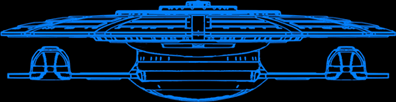 Like most Starfleet vessels, the Katana class frigate is made up of a saucer-shaped primary
hull, which sits on top of a long secondary hull. Attached to the secondary hull by two
struts are the ship's warp nacelles, which are used to travel between stars.
Like most Starfleet vessels, the Katana class frigate is made up of a saucer-shaped primary
hull, which sits on top of a long secondary hull. Attached to the secondary hull by two
struts are the ship's warp nacelles, which are used to travel between stars.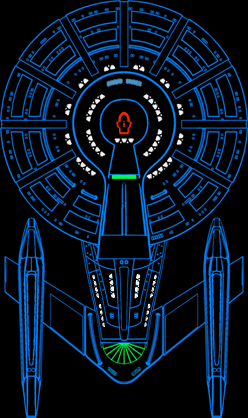 The image at right highlights the Bridge, or command center, of the ship in red. This is
where the Captain and the senior officers direct the actions of the ship. Also highlighted
on this image in green are the ship's two standard shuttlebays. The main shuttlebay is
located at the far aft of the ship. From here, the ship can launch and recover personal
shuttles, cargo shuttles, shuttlepods, and fighters -- small independent spacecraft that
the crew sometimes use for missions or shore leaves away from the starship.
The image at right highlights the Bridge, or command center, of the ship in red. This is
where the Captain and the senior officers direct the actions of the ship. Also highlighted
on this image in green are the ship's two standard shuttlebays. The main shuttlebay is
located at the far aft of the ship. From here, the ship can launch and recover personal
shuttles, cargo shuttles, shuttlepods, and fighters -- small independent spacecraft that
the crew sometimes use for missions or shore leaves away from the starship.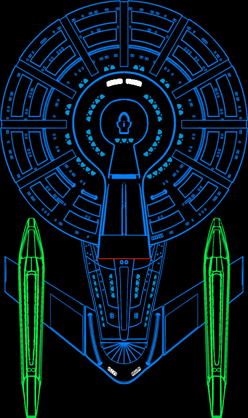 Most of the races and alliances in this part of the galaxy, including ours, use the principle
of warp drive to move their starships from star to star. Warp drive involves creating a
bubble of "subspace" around the ship, a extra-dimensional area where the speed of light is
much higher than it is in normal space. The starship then can use its impulse, or sublight,
engines to drive the ship through this bubble of subspace. The subspace bubble, however,
remains centered around the ship's two warp engines, which stay with the ship. Each point
in subspace has an equivalent point in normal space. So, a subspace bubble can be created,
impulse engines used from within it for a time, and then the subspace bubble is collapsed...
and from an outside viewer's perspective, enormous distances are crossed in very little time!
Most of the races and alliances in this part of the galaxy, including ours, use the principle
of warp drive to move their starships from star to star. Warp drive involves creating a
bubble of "subspace" around the ship, a extra-dimensional area where the speed of light is
much higher than it is in normal space. The starship then can use its impulse, or sublight,
engines to drive the ship through this bubble of subspace. The subspace bubble, however,
remains centered around the ship's two warp engines, which stay with the ship. Each point
in subspace has an equivalent point in normal space. So, a subspace bubble can be created,
impulse engines used from within it for a time, and then the subspace bubble is collapsed...
and from an outside viewer's perspective, enormous distances are crossed in very little time! Unfortunately, sometimes it is necessary for a Starfleet veseel to defend itself.
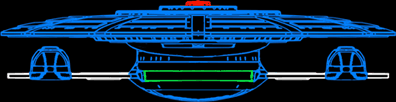 Here is the front view again, this time highlighting many of the features that you have
already seen in the other views. Again, the Bridge in this view is highlighted in red.
While it would make sense to place the command center deep within the ship, Starfleet does
not do this.
Here is the front view again, this time highlighting many of the features that you have
already seen in the other views. Again, the Bridge in this view is highlighted in red.
While it would make sense to place the command center deep within the ship, Starfleet does
not do this.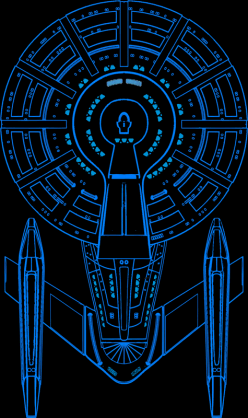 This is a Katana class frigate when viewed from the top. Note the phaser collimator rings on the saucer
section. Imagine a large oval drawn around the ship -- this would represent the active shields. These
are only used to protect the ship from dangers in space, or the weapons of hostile starships.
This is a Katana class frigate when viewed from the top. Note the phaser collimator rings on the saucer
section. Imagine a large oval drawn around the ship -- this would represent the active shields. These
are only used to protect the ship from dangers in space, or the weapons of hostile starships. © Copyright 2003,