
| History of the Katana Class Starship | |
|||||||||||||||||||||||||||||||||||||||||||||||||||||||||||||||||
 The Katana class frigate, developed at Utopia Planitia Starfleet Yards, Sol IV, has
had one of the most unusual development cycles ever for a Starfleet vessel.
The Katana class frigate, developed at Utopia Planitia Starfleet Yards, Sol IV, has
had one of the most unusual development cycles ever for a Starfleet vessel.In late 2371, Captain Vionau Rytak, then commanding Utopia Planitia's Theoretical Propulsion Group, was tasked to put together several possible models for a next generation starship. It was a long range project, and the design team did not receive any physical materials or dock space. It was entirely a thought experiment -- what would the next generation of Starfleet vessels look like? During the first two years, most of the time spent working on the project was done after hours. The initial drawing of what eventually became the Katana class was first done on a cocktail napkin! Several other theoretical designs were also being considered, including what eventually became the Artemis class starship. When the smoke cleared sometime in 2374, a model for the Katana class existed that was not very different from what was later constructed: it had detachable saucer segments reminiscent of the Nebula class cruiser and variable geometry nacelle struts and bioneural circuitry cribbed freely from the Antares Fleet Yard's design for the Intrepid class destroyer. Designated a frigate, the Katana class seemed an ideal design to replace aging Excelsior class ships on Threat force borders. Theoretical models predicted she would be especially well-suited to dealing with attacks by Jem'Hadar assault fighters. Her multi-mission capability could also be applied to different mission protocols common to the Federation border. Unfortunately, when the war ended in 2375, the rush to build the ship slowed, then halted. Resources were needed to repair the existing fleet and starbases, and the urgency for new starships on the front lines was blunted. There didn't seem to be any actual reason to press forward with the construction of Katana class starships. Once new starship construction restarted in the late 2380s, the Katana class had been forgotten and several other designs entered the queue, including the new Vigilant class.
The salvation of the Katana class came later that year from a completely unexpected direction: Delta quadrant. In a detailed series of logs and technical information briefings, U.S.S. Voyager, NCC-74656 sent Starfleet an enormous amount of information about the cultures, races, and technologies available on the far side of the galaxy. One of the technical briefings detailed various advanced propulsion technologies, including detailed scans of a Borg transwarp conduit and technical details of another propulsion method known as quantum slipstream propulsion. This information was duly passed to Utopia Planitia, where it sat in a classified database for the next five years, until Voyager found her way home through a Borg transwarp conduit, the direct descendant of slipstream. Suddenly, the rush was on to produce a starship built around one of the new propulsion technologies. Unfortunately, it was later learned that Voyager's successful use of both slipstream and transwarp was a complete fluke. In the case of her use of slipstream, in particular, it was discovered that there was an 85% chance that a vessel passing through slipstream with Voyager's Z-axis compression would be destroyed or severely damaged. Obviously, Voyager had been incredibly fortunate in its successful transit. For years, designers at both Utopia Planitia and the Antaras Fleet Yards attempted to produce a stable, operational transwarp core. To this day, such cores are rare, the successful replication of captured Borg transwarp cores almost non-existent. With the possibility of mass-producing a transwarp drive frustratingly remote, the designers turned their attention fully to producing a functional slipstream core. However, none of the existing starship designs had been produced with this propulsion method in mind, and few of them were up to the challenge.
Several dozen successful tests were run on vehicles from 1.8 to 16.4 meters long, but no vehicle larger than 16.4 meters survived the quantum threshhold for more than 15 or 20 seconds at a time. While the 16.4 meter length might one day be useful for a shuttlecraft or fighter design, Starfleet wanted a starship with a minimum crew size of 300 to be able to make the transit with an acceptable degree of risk. The design characteristics also called for a multimission vessel, since it was not known who the primary contractor of such a slipstream-capable starship might be. Certainly, the Exploration division could rise to new heights with the technology, and it would allow the Military division to respond to trouble spots with incredible quickness. Intelligence and Transport also expressed interest in a slipstream-capable starship for the pure speed of transit available. This wide interest meant that any vehicle able to survive the quantum threshhold would also have to be capable of handling many possible mission profiles. Those two factors, combined with the standards of Starfleet vessels of the day (two years cruising time, acceptable crew comforts, able to defend itself with phaser and torpedo weapons, transporters, shields, etc.) made creating an acceptable design an almost impossible task.
The needed breakthrough was finally achieved in 2391, when it was discovered that a ship could safely pass through a slipstream conduit if it possessed both a 45 degree Z-axis compression and a way to neutralize the subspace field stresses of her warp nacelles through the conduit (or eliminate the warp nacelles entirely). The simplest method known to do this was to use variable geometry warp nacelles or struts -- during a slipstream transit, the nacelles could be "stored" in an energy-neutral position. Further tests defined a size envelope for the vessel passing through the conduit: between 900,000 and 1.5 million metric tonnes.
That birth was not without trauma: two starship construction facilities were tasked with the first four Katana class starships, Andor (Katana, Renegade) and Sol IV (Coronado, Hunter). Katana and Coronado began construction almost simultaneously, in March 2393. However, the two teams took their competition to an unhealthy level, each team wanting to be the first to launch their ship. Both teams were convinced that a new age in Starfleet history was about to be born, and both teams wanted their names on that new age. As a result, the new age nearly did not happen. Cost and materials overruns ran rampant through both teams, and several Admirals nearly cancelled the entire project due to the problems. In addition, the Katana class has had its detractors since it came off the drawing board, with many in Starfleet Engineering circles linking it, not affectionately, to the failure of the original Excelsior's attempt to harness transwarp in the mid-23rd century. The backers of the Katana class pointed to the Excelsior's long and distinguished service to Starfleet and pressed on. Twice, radicals attempted to disrupt construction at the Mars facility.
This history does not need to cover the first official slipstream test -- that event was well-documented by the Federation News Service, and was every bit as historic as the Katana design team dreamed it would be. Coronado initiated a slipstream conduit just outside the orbit of Pluto, and arrived in the Alpha-Centauri system, some 4.3 light-years away, in just over 16 minutes. Previously, such a journey would have taken some 12 hours at high warp. Slipstream velocity was possible, was safe, and could be incorporated successfully into Starfleet vessels. Today, there are four Katana class frigates assigned to various branches of Starfleet, and configured for four different mission profiles. The class ship, U.S.S. Katana, was assigned to Starfleet Exploration, and is configured for science, exploration, and research. Coronado is assigned to Starfleet Intelligence and carries a small Marine company. Renegade is currently serving in the Military division of Starfleeet, and carries an extensive sensor and communications package. Finally, Hunter is currently undergoing tests by the Starfleet Secret Service, which may choose to develop the Katana class further. The ships are being closely watched in all branches of Starfleet, a situation that will hopefully not work against the success of the new vessel. Certainly, the Katana and her sisters have yet to prove themselves. But if they do, can the new age for Starfleet promised in their design be far away?
Stardate 240109.21 Since the above was written in June 2399, the Katana class vessels have more than bourne out the hopes and dreams of their creators, and the original purchase of four, and then eight vessels has been expanded to 64. In the process, some differentiation has been introduced between the original "flight 1" Katana class spec and the more specialized "flight 2" variant.
In addition, nacelle length has been increased in the flight 2 vessels and nacelle struts are somewhat more robust. The overall effect is to create a somewhat more combat-capable vessel in the flight 2s, and this series of vessels has been relegated to more traditional frigate duties, such as intelligence, counter-intelligence, and Marine transport. However, the Katana class vessels are proving themselves in the field, and the greatly increased order is just one sign of that. These beautiful ships will be plying the spacelanes for decades to come!
Once you're done here, tap Back to return to the Coronado information index or the Return key at the bottom of your PADD, and you will be returned to the main index. | ||||||||||||||||||||||||||||||||||||||||||||||||||||||||||||||||||
| The U.S.S. Coronado model was created by Ryan McClure. The Katana class design was created by Rick Sternbach, and appeared in the ST:TNG Technical Manual. It was modified for U.S.S. Coronado by Mark Kingsnorth, Fraser Deziel, and Ryan McClure. Reproduction or use of Coronado images in any form is strictly prohibited without the prior written authorization of the site author and digital modeller per this site's terms of use. |





 Star Trek®,
Star Trek: The Next Generation®, Star Trek: Deep Space Nine®, and Star Trek: Voyager®
are registered trademarks of Paramount Pictures
in the United States Patent and Trademark Office. Use of this site constitutes your
acceptance of these terms of use.
Star Trek®,
Star Trek: The Next Generation®, Star Trek: Deep Space Nine®, and Star Trek: Voyager®
are registered trademarks of Paramount Pictures
in the United States Patent and Trademark Office. Use of this site constitutes your
acceptance of these terms of use.
|
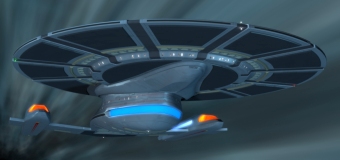 Worse yet, the overall Starfleet direction was changing from multi-mission capable
ships to those that were specifically designed for their missions. With the
Dominion War in full swing, no specific branch in Starfleet wanted to provide
resources for a design not geared toward their specialty. Exploration felt the
Katana class wasn't fast enough. Military didn't like her weapons suite.
Intelligence was mildly interested, but not interested enough to front the materials
needed. The list went on.
Worse yet, the overall Starfleet direction was changing from multi-mission capable
ships to those that were specifically designed for their missions. With the
Dominion War in full swing, no specific branch in Starfleet wanted to provide
resources for a design not geared toward their specialty. Exploration felt the
Katana class wasn't fast enough. Military didn't like her weapons suite.
Intelligence was mildly interested, but not interested enough to front the materials
needed. The list went on.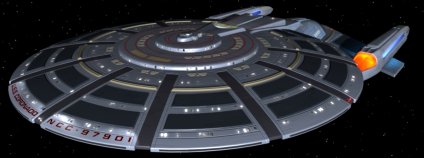 Clearly then, a completely new design was going to be required that allowed a
Starfleet vessel to pass through a slipstream with an acceptably low chance of
damage to the vessel. That goal was extremely elusive. One of the most
difficult tasks involved in designing the new vessel was creating a design that
would both hold a sufficient crew and could survive the slipstream environment.
Clearly then, a completely new design was going to be required that allowed a
Starfleet vessel to pass through a slipstream with an acceptably low chance of
damage to the vessel. That goal was extremely elusive. One of the most
difficult tasks involved in designing the new vessel was creating a design that
would both hold a sufficient crew and could survive the slipstream environment. By the late 2380s, the project had almost completely stalled. Though some Starfleet
vessels had passed through transwarp conduits safely, only the largest ships, such as
Galaxy or Sovereign classes, could attempt it and hope to survive. Two smaller vessels
that had attempted it had been crushed by the field stresses. Slipstream seemed to be
geared toward vessels of more common Starfleet size... theoretically. Some way of
neutralizing the effect of the vessel's nacelles through the conduit would have to
be achieved, assuming a slipstream-capable vessel carried nacelles at all.
By the late 2380s, the project had almost completely stalled. Though some Starfleet
vessels had passed through transwarp conduits safely, only the largest ships, such as
Galaxy or Sovereign classes, could attempt it and hope to survive. Two smaller vessels
that had attempted it had been crushed by the field stresses. Slipstream seemed to be
geared toward vessels of more common Starfleet size... theoretically. Some way of
neutralizing the effect of the vessel's nacelles through the conduit would have to
be achieved, assuming a slipstream-capable vessel carried nacelles at all.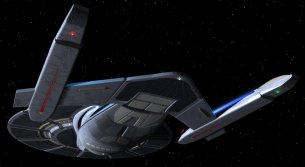 Starship designers went back to their drawing boards, attempting to develop or find
a design that would meet the three slipstream criteria, and still be suited to the
wide variety of mission profiles necessary. Within a year, two separate design teams
had "rediscovered" the Katana class sitting in a design archive and had independently
reached the same conclusion -- the Katana class could be modified to meet the criteria
defined for the slipstream-capable starship. Computer models confirmed this and helped
refine the design still further. The Katana class would finally be born.
Starship designers went back to their drawing boards, attempting to develop or find
a design that would meet the three slipstream criteria, and still be suited to the
wide variety of mission profiles necessary. Within a year, two separate design teams
had "rediscovered" the Katana class sitting in a design archive and had independently
reached the same conclusion -- the Katana class could be modified to meet the criteria
defined for the slipstream-capable starship. Computer models confirmed this and helped
refine the design still further. The Katana class would finally be born.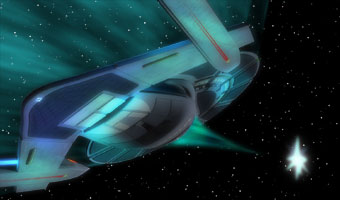 Meanwhile, the Andor facility was having troubles of its own. Several potential
design flaws popped up late in 2398, requiring that a portion of the Katana's power
distribution network and warp plasma relays be rerouted. The team from Andor was
furious, especially since they had been well ahead of their colleagues working on
Coronado. It was even hinted by the Andorian team that the Mars team had
sabotaged their efforts to launch the class ship first. Meanwhile, the team working
on Coronado were able to take advantage of the lessons learned on Katana
and rapidly incorporated the design changes. U.S.S. Coronado was officially
commissioned on July 26, 2399.
Meanwhile, the Andor facility was having troubles of its own. Several potential
design flaws popped up late in 2398, requiring that a portion of the Katana's power
distribution network and warp plasma relays be rerouted. The team from Andor was
furious, especially since they had been well ahead of their colleagues working on
Coronado. It was even hinted by the Andorian team that the Mars team had
sabotaged their efforts to launch the class ship first. Meanwhile, the team working
on Coronado were able to take advantage of the lessons learned on Katana
and rapidly incorporated the design changes. U.S.S. Coronado was officially
commissioned on July 26, 2399. The flight 1 -- the original design -- is more generalized, able to meet a wider array of
mission profiles, including successful Katana class starships in multiple roles,
including exploration, border support and patrol, and heavy escort. The flight 2 design
incorporates an expanded Hornet launch bay in the upper saucer, as well as an unusual
series of "launch catapults" aft of those bays, intended for a wing of Spectre class
fighters. Interior room is increased somewhat, at the expense of greater mass and a smaller
array of modules that can be mounted on the flight 2 vessels.
The flight 1 -- the original design -- is more generalized, able to meet a wider array of
mission profiles, including successful Katana class starships in multiple roles,
including exploration, border support and patrol, and heavy escort. The flight 2 design
incorporates an expanded Hornet launch bay in the upper saucer, as well as an unusual
series of "launch catapults" aft of those bays, intended for a wing of Spectre class
fighters. Interior room is increased somewhat, at the expense of greater mass and a smaller
array of modules that can be mounted on the flight 2 vessels. © Copyright 2003,